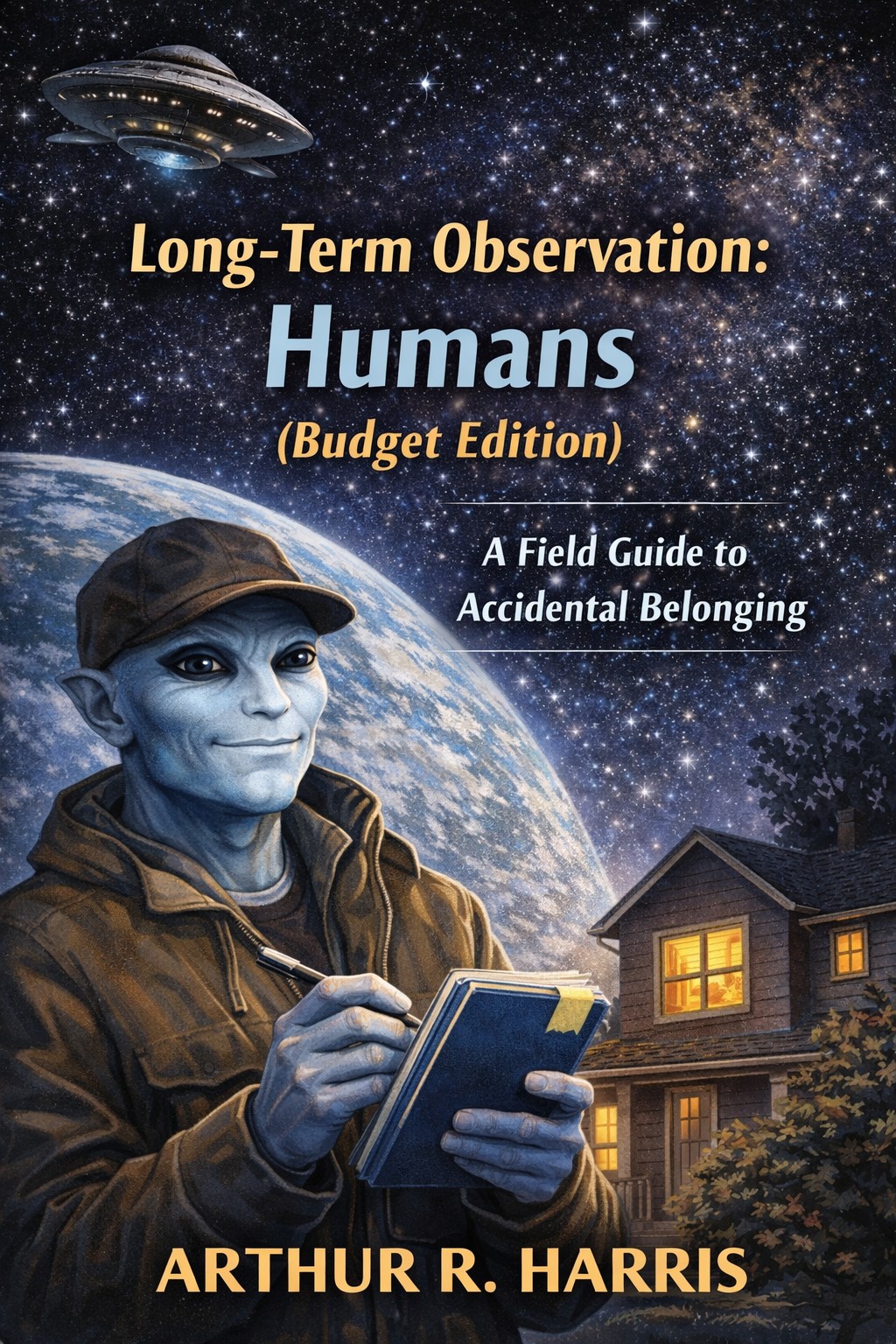
Book 1 Long-Term Observation: Humans, (Budget Edition)
A dryly comedic field record presented as an alien’s retirement log. Compiled by a reluctant off-world engineer who selected Earth for its low cost and high mortality, the volume documents human behavior with technical precision: family dynamics, food rituals, weather fixation, and recurring social inefficiencies.
What begins as detached observation remains methodical. Systems are noted. Anomalies are logged. Survival proves less demanding than projected. Certain interactions, however, resist clean classification and recur without clear justification.
No conclusions are reached. Continued observation is recorded.
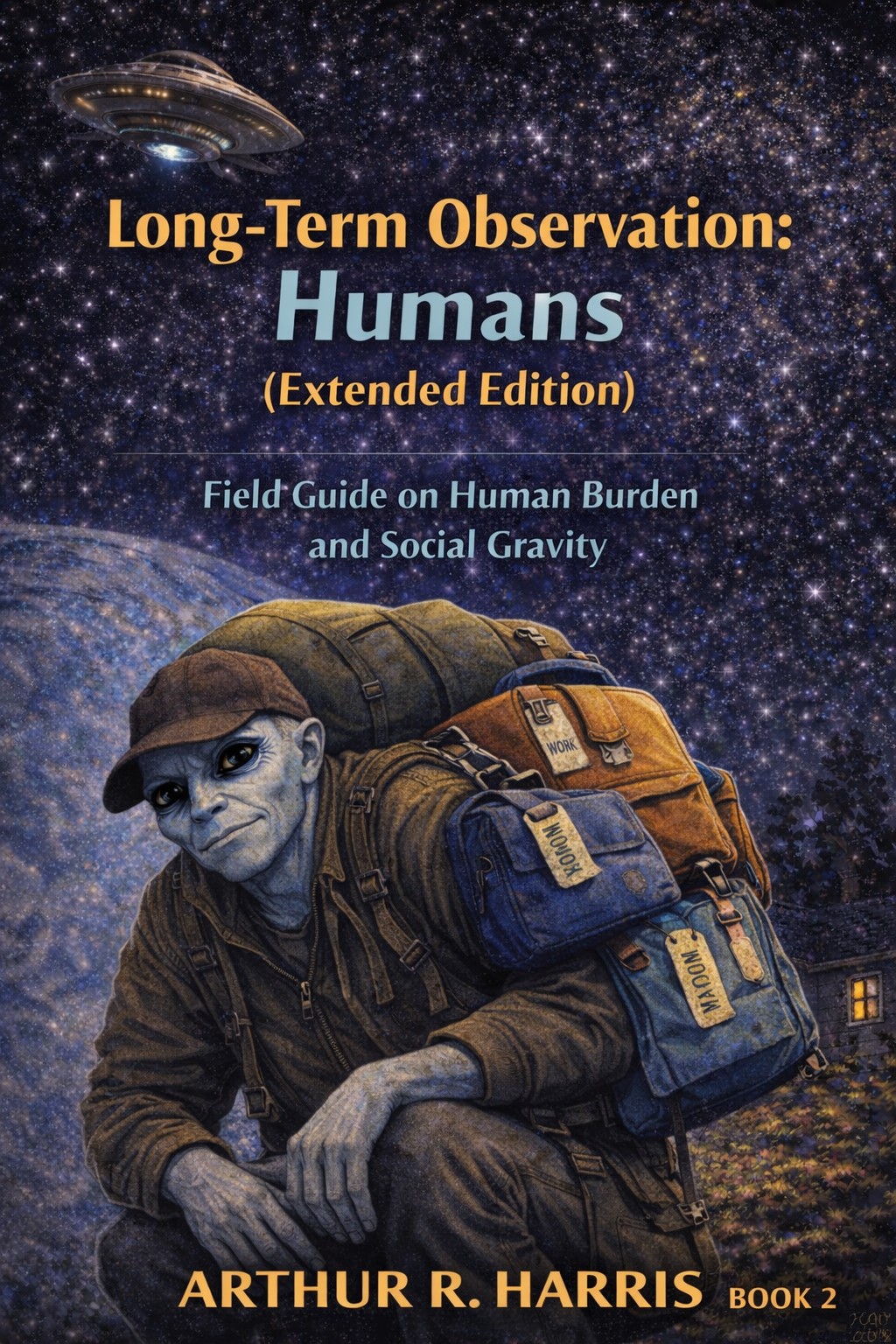
Book 2 Long-Term Observation: Humans (Extended Edition)
In the Extended Edition, the record shifts from location to load. Arthur catalogs the weight humans accumulate over time and the social gravity that prevents it from being set down. Responsibilities stack, roles compress, and informal systems absorb stress without visible failure.
Much of this weight is not assigned. It is inherited, assumed, or quietly accepted in the absence of alternatives. Tasks persist beyond their original necessity. Support structures adapt without recognition, and endurance becomes the primary stabilizing mechanism.
From the outside, the system remains operational. From within, complexity increases as weight redistributes rather than disappears. No collapse is observed. The load is simply carried.
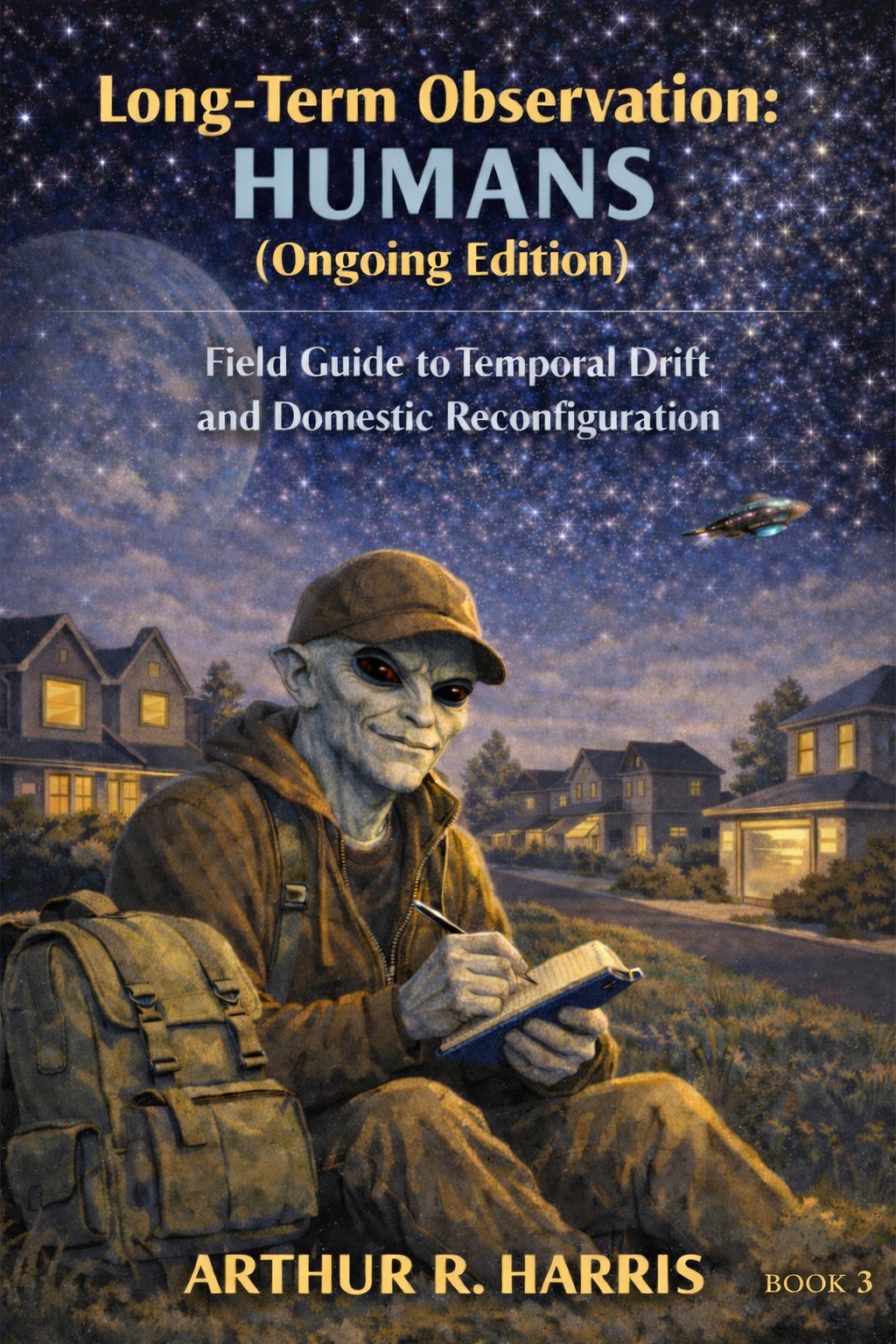
Book 3 Long-Term Observation: Humans (Ongoing Edition)
In Ongoing Edition, Arthur documents systems that appear stable while quietly changing underneath. Routines repeat, configurations hold, and daily operations continue without visible disruption. No alerts are triggered. No intervention appears necessary.
Over time, however, repetition itself becomes the mechanism of change. Minor adjustments accumulate. Access ranges widen. Assumptions once treated as temporary begin to harden into default states. By the time deviation is detectable, reversal is no longer a viable option.
Human life, Arthur observes, rarely announces transition. It does not pause, reset, or request approval. It simply continues—slightly reconfigured—until the new direction becomes indistinguishable from normal.
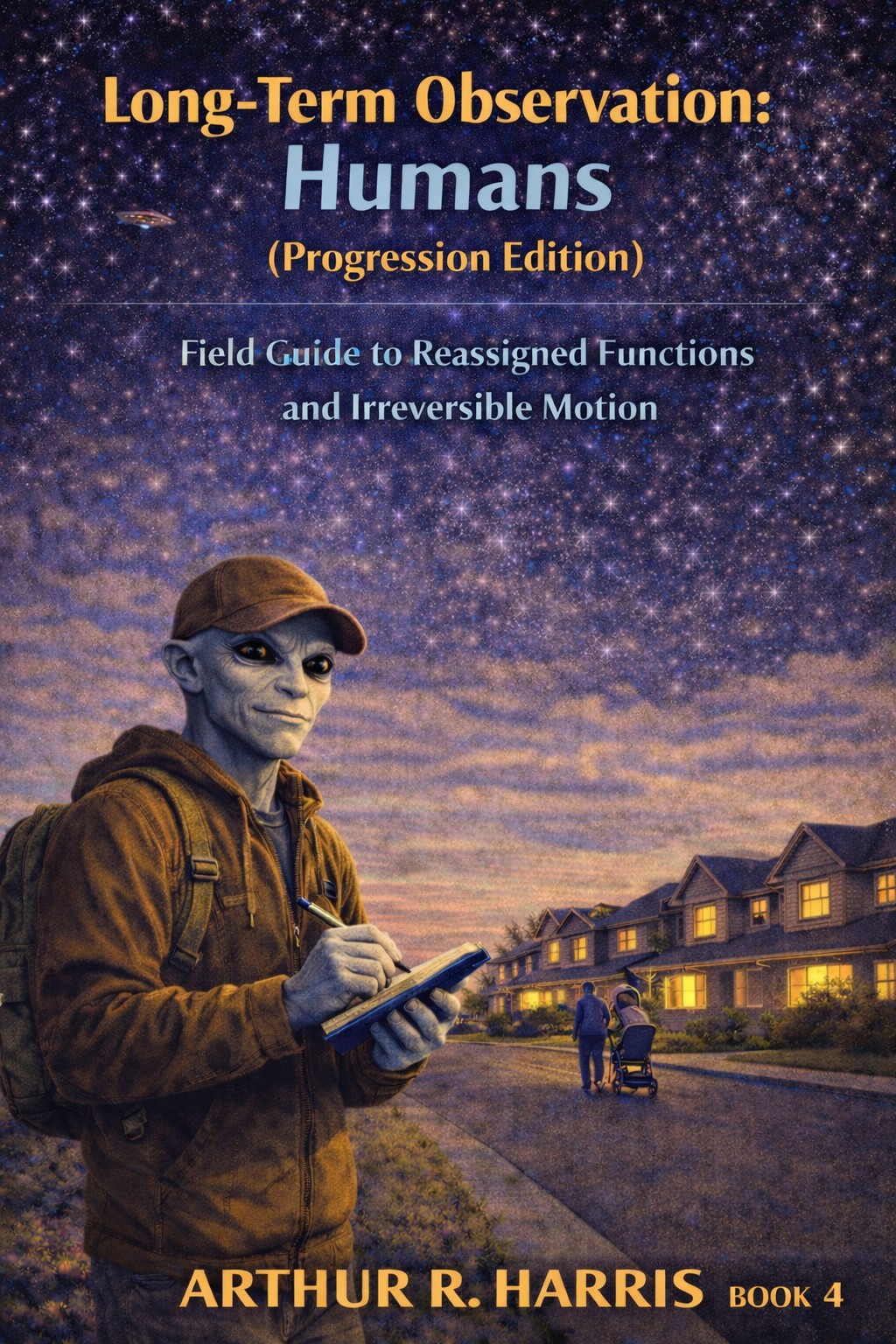
Book 4 Long-Term Observation: Humans (Progression Edition)
In Progression Edition, we see a transition from proximity to involvement. Conditions previously observed at a distance begin to require response, and boundaries assumed to be stable prove negotiable under sustained pressure. Environmental controls remain nominally external, but domestic systems increasingly register Arthur as a functional component.
Responsibility reallocates without formal agreement. Observation windows narrow. Actions undertaken for containment purposes persist beyond their intended scope. While no singular incident is identified as causal, cumulative change renders prior classifications insufficient.
Documentation continues. Neutrality is maintained where possible. No conclusions are reached.

Book 5 Planned Final Volume
The fifth volume of Long-Term Observation: Humans is planned as the final entry in Arthur’s observational record. It is intended to document the long-term consequences of sustained proximity, accumulated responsibility, and continued survival beyond original projections.
Where earlier volumes record load, drift, and reassigned function, this volume is expected to address persistence: what remains after adaptation becomes permanent and observation can no longer be cleanly separated from participation. No structural reset is anticipated.
Compilation is pending. Assumptions remain under review. Departure is not considered.