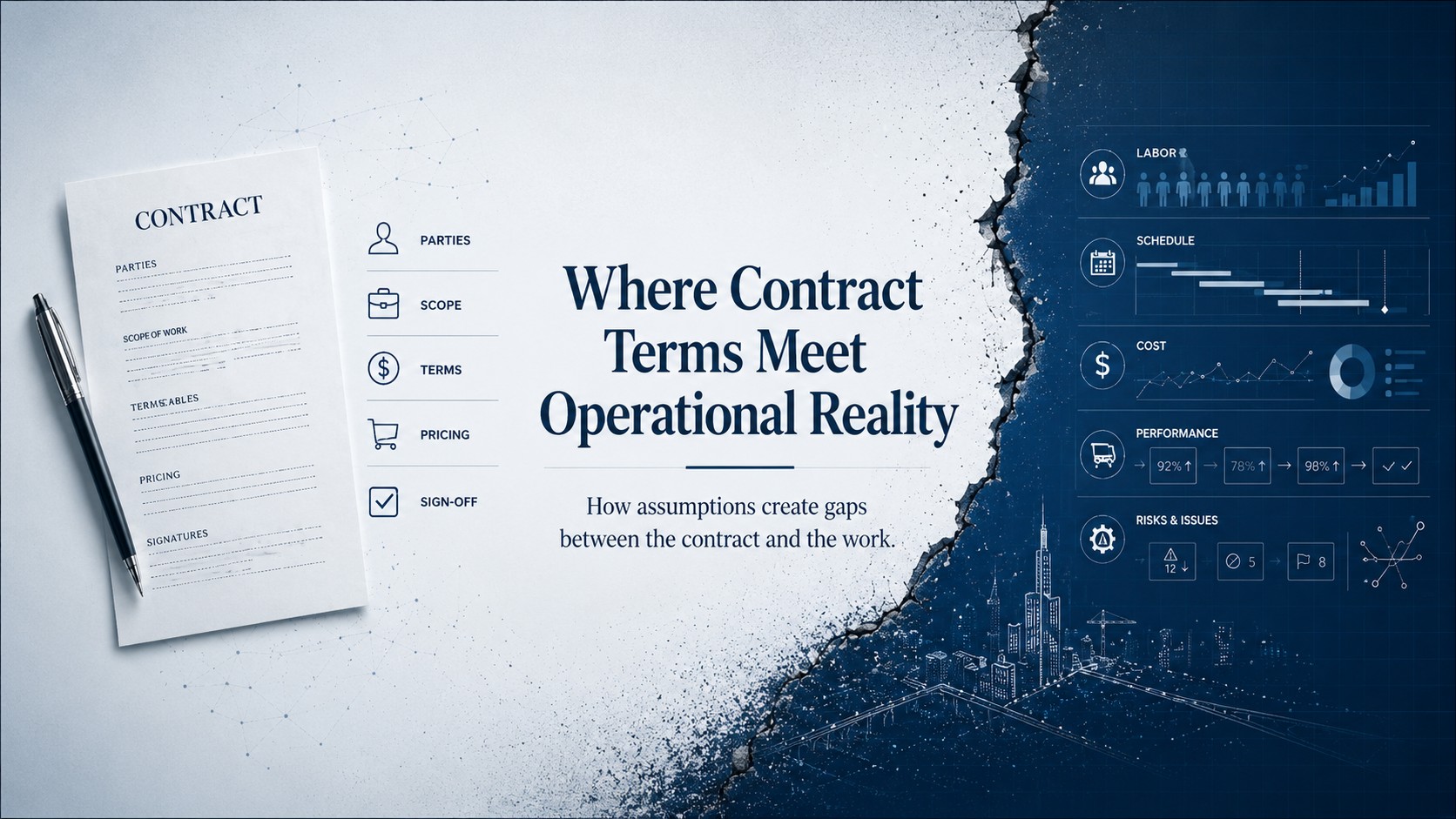
A contract can define the work, assign responsibility and risk, and establish available funding. It cannot perform the work itself.
People must turn contractual requirements into staffing plans, budgets, schedules, purchasing decisions, reporting systems, and daily operations. That translation creates a natural fault line—a place where two systems meet and where differences between them may remain unnoticed until pressure exposes them.
Many contract problems arise along that line.
Sometimes the contract language is unclear. Just as often, the language is reasonably clear, but performance is shaped by assumptions: that a requirement has not changed, that a planning estimate is a promise, or that similar-looking products are equivalent.
Over the years, I have seen this gap take several forms. What the contract says can differ substantially from how people expect the work to operate.
Familiar Work Can Still Bring New Requirements
Long-running programs can foster complacency. When an organization has performed essentially the same work for years—or even decades—people naturally expect the next contract to resemble the last.
The customer, work, and employees are familiar, so the transition may seem like little more than a continuation under a new contract number.
Yet a follow-on contract is still a new agreement.
In one case, an experienced workforce had performed successfully for years. The new contract added bachelor’s-degree requirements for several positions, but the transition did not fully account for the operational impact.
The employees remained capable and retained years of relevant knowledge and experience. Even so, several no longer met the new contract’s formal qualifications.
The staffing model remained the same, but the contractual requirements had changed.
This distinction matters. Someone may be capable of doing the job yet still be contractually unqualified for a specific labor category. Discovering that after performance begins can force difficult decisions about staffing, recruiting, customer communication, cost, and schedule.
A direct comparison of the new contract’s qualification requirements against the existing workforce during the proposal phase could have exposed the issue earlier, rather than relying on the assumption that familiar work carried familiar requirements.
A Ceiling Does Not Guarantee a Minimum
Planning assumptions create a different risk.
Organizations must forecast workshare, revenue, staffing, materials, and future opportunities. Projections are necessary, but risk arises when an optimistic estimate is gradually treated as a contractual commitment.
Suppose an agreement caps the percentage of work that may be allocated to a participant. For planning purposes, business-development or program personnel may estimate that the organization will receive work near or even at that limit.
That estimate may flow into revenue forecasts, hiring plans, budgets, staffing discussions, and management presentations. Repetition can make the forecast seem increasingly certain.
Eventually, a possibility may be treated as an expectation.
But a ceiling sets the maximum available. It does not guarantee a minimum.
If actual workshare falls below the optimistic forecast, the organization may feel it has lost something, even though the contract never promised that amount.
The problem is not necessarily the calculation. It is allowing the assumption to drift away from the language that supported it.
Forecasts are essential, but they must remain clearly labeled as forecasts. Contractual rights, contractual obligations, management targets, and optimistic projections are distinct. Blurring them can lead organizations to make real commitments based on work that was never guaranteed.
The Lowest Price May Not Produce the Lowest Acceptable Cost
Purchasing is another area where contract terms and operational reality can diverge.
In one case, a contractor had to purchase materials and tools for performance. After authorized supplier quotes and expected delivery dates were submitted, an online search appeared to show the same products at a fraction of the price.
At first, the comparison seemed simple. If two items looked alike and had similar descriptions, why pay more?
But the advertised price did not answer every important question.
Were the items made by the specified manufacturer and compliant with the required specifications? Was the seller authorized? Could the source provide traceability, warranty coverage, quality records, or certifications? What risk existed that the products might be counterfeit, off-brand, used, altered, or otherwise nonconforming? Would they arrive on time, and what remedy would be available if they did not?
A low-cost marketplace item may work perfectly well and still be unsuitable for the contractual requirement. A photograph and brief description do not always establish equivalence.
The key question was not simply, “Where can we buy this for less?”
The better question was, “What must we provide, and what evidence will prove that the item meets the requirement?”
A lower purchase price does not necessarily mean a lower contract cost. If an item fails inspection, lacks required documentation, delays performance, loses manufacturer support, or requires replacement, the apparent savings can vanish quickly.
The Fault Line Is Usually an Assumption
These cases involve different issues—personnel qualifications, workshare, and purchasing—but the fault line formed in the same place.
In each case, an assumption filled the gap between the contract and the operating plan.
The staffing assumption was that a familiar workforce would remain contractually qualified.
The business assumption was that the maximum potential workshare would function as an expected minimum.
The purchasing assumption was that similar-looking online products were equivalent to items obtained through established suppliers.
None of these assumptions was unreasonable when viewed from a single role’s perspective. The problem was that no single perspective captured the whole picture.
Program personnel understand how the work is performed. Business-development personnel understand the opportunity and growth strategy. Procurement understands sources, lead times, and purchasing requirements. Finance understands budgets and forecasts. Human resources understands hiring and qualifications.
Contracts personnel understand the agreement, but they may not see how every requirement affects daily performance unless they remain connected to the operating team.
Effective contract administration connects these perspectives.
It involves more than finding a clause after a problem emerges. It requires assessing how new requirements affect the workforce, separating estimates from commitments, testing apparent equivalencies, documenting decisions, and identifying consequences before assumptions become embedded in operations.
Clarification is not needless bureaucracy. One early question can prevent months of staffing problems, financial disappointment, purchasing disputes, or schedule disruption.
The Contract Is the Foundation, Not the Whole Structure
A contract provides the legal and operational foundation for the relationship, but successful performance requires more than reading its terms correctly.
Organizations must deliberately translate those requirements into hiring, planning, purchasing, reporting, and performance. Habit, optimism, and appearances are poor substitutes.
Familiar work may carry new requirements. A ceiling may support a forecast without creating an entitlement. A lower-priced product may not satisfy the same obligation.
The contract defines what the parties agreed to do. Effective contract administration helps keep the organization’s assumptions, systems, and daily decisions aligned with that agreement—and helps identify the fault lines before pressure turns them into failures.