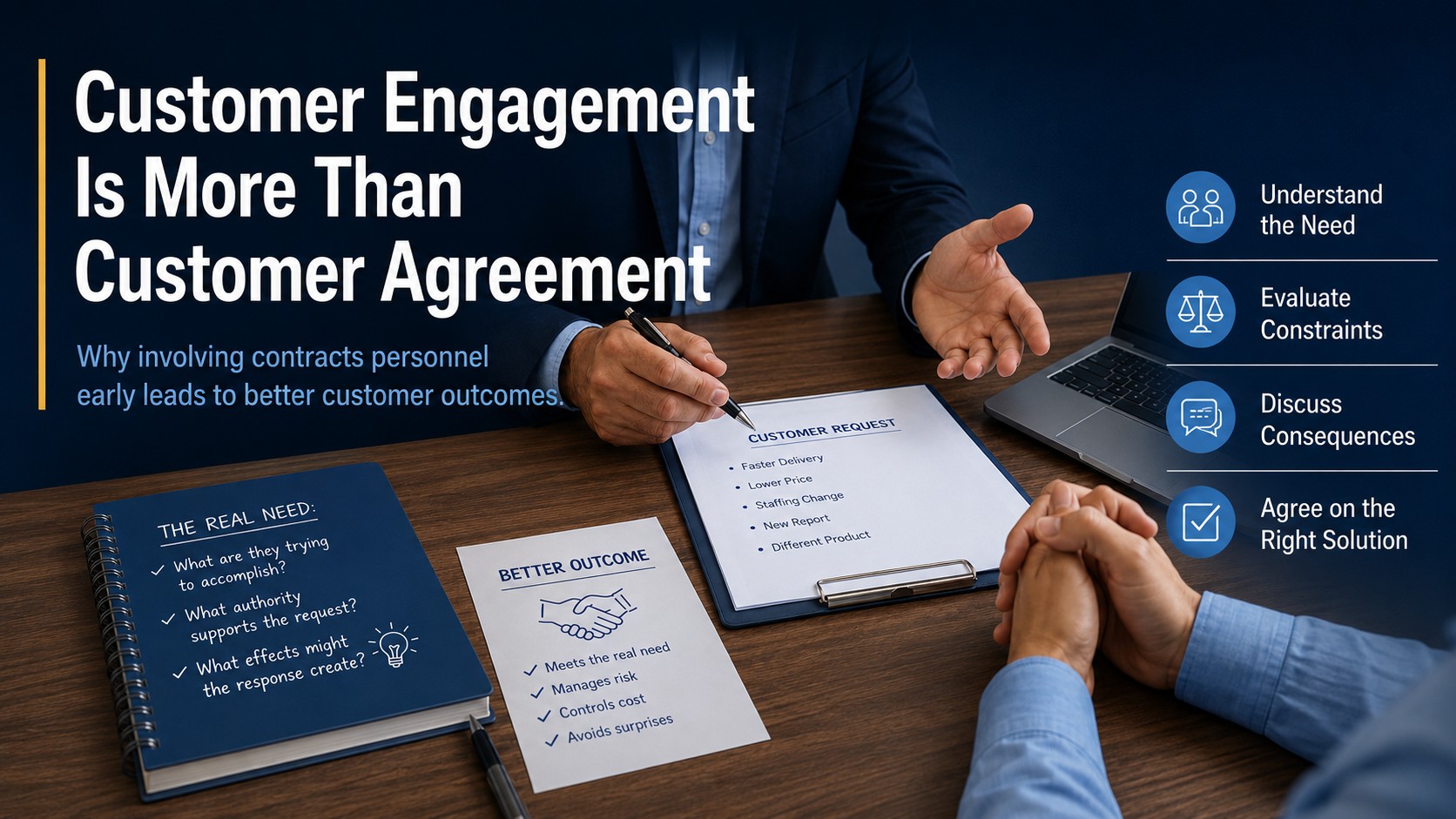
The customer is not always right—at least not about the solution. A customer may be pleased in the moment because a contractor said yes, but that does not necessarily mean the customer was served well. The customer may understand the outcome it wants without seeing every contractual, technical, financial, or procurement consequence of the requested approach. Real customer engagement is therefore not automatic agreement. It is the discipline of understanding what the customer is trying to accomplish, identifying the constraints on both sides, and considering the consequences before anyone makes a commitment.
A quick answer can create expectations involving scope, cost, schedule, staffing, funding, technical performance, security, subcontractors, or other deliverables. A request may be operationally simple but contractually significant, or contractually permissible but operationally disruptive. That is why contracts personnel should be involved early—not after a well-intended response has become an unintended obligation.
Look Beyond the Immediate Request
Customers may ask for faster delivery, a lower price, a staffing change, a new report, a different product, or work outside the original plan. The request is only the visible part of the issue. The potential fault line—the place where customer expectations, contractual authority, technical requirements, and operational reality do not align—often lies beneath the immediate request. Before answering, the team should ask what problem the customer is trying to solve, what authority supports the request, and what effects the proposed response may create.
The first question should not always be, “Can we do that?” Sometimes it should be, “What are you trying to accomplish?” That question creates room for a solution that meets the real need without adding unnecessary work or risk.
When a One-Time Report Becomes a Recurring Deliverable
In one case, a customer asked a technical employee for what appeared to be a simple, one-time report. The technical employee agreed without consulting the contracts representative. After receiving the report, the customer expected a similar 15-page report every month for the remainder of the contract.
The report itself was not especially difficult to prepare, but gathering the information and generating it required recurring effort that had not been planned. A small, informal commitment had propagated, spreading into recurring work, staffing demands, and cost for the remainder of the contract.
Once the contracts representative became involved, the conversation changed. Instead of treating the requested format as the only solution, the team discussed the customer’s underlying information need. The customer ultimately agreed to modify an existing required report to include selected additional information. The customer received the visibility it needed, while the contractor avoided maintaining two separate reports.
This was not a case in which contracts personnel merely said no. Their involvement helped the team understand the request, evaluate the obligation, and develop a more efficient alternative. Had they been included before the original agreement, the team might have avoided the unintended monthly expectation altogether.
When the Cheapest Purchase Costs More
In another case, a customer asked purchasing to obtain a lower-priced tool from an online retailer instead of buying the approved tool through the authorized supplier at a substantially higher price. The request was a customer preference based solely on price, not a binding contractual obligation. Purchasing nevertheless agreed without first coordinating with contracts personnel and without adequately confirming that the substitute would perform the required task.
The cheaper tool did not meet the actual operational need. The team then had to purchase the correct tool, eliminating the expected savings and causing a schedule slip while the correct tool was ordered and delivered. Because the first tool had been bought outside official supplier channels, the contractor also had to absorb its cost.
What looked like a customer-friendly decision created additional expense, a delay, and unnecessary procurement activity. Early coordination among purchasing, technical staff, and contracts personnel could have clarified that the request was not contractually binding, verified the technical requirement, and preserved the protections provided by the authorized purchasing channel.
Respectful Disagreement Is Part of Good Service
The familiar idea that “the customer is always right” can become harmful when it is interpreted to mean that every requested method should be followed without question. A contractor should not be obstructive, but automatic agreement is not the standard for customer service. The customer may be right about the need while being mistaken about the best way to meet it. Sometimes the most valuable response is to explain that a request may create an unintended issue, affect cost or schedule, fall outside the current agreement, or require documentation before work proceeds.
Respectful disagreement handled early is often better customer service than silent compliance followed by a problem. It gives the customer the information needed to make an informed decision and gives the contractor an opportunity to offer alternatives.
No Surprises Is a Practical Standard
Good engagement means identifying and discussing emerging risks, delays, funding concerns, unclear requirements, staffing problems, and assumptions that may no longer be valid. The customer should not first learn about a problem when a deadline is missed, an invoice is questioned, or a promised deliverable proves impractical.
Many surprises begin as small fault lines: an untested assumption, an unclear responsibility, or a casual commitment whose consequences have not yet become visible. Not every problem can be prevented, but many surprises can. Early involvement by contracts personnel helps the team identify whether a request is authorized, whether it changes an obligation, and whether the proposed response has consequences that are not immediately obvious.
The Contracts Professional as a Connector
Contracts personnel should not be isolated as the people who say no or quote clauses. Their value lies in connecting the customer, program team, finance, procurement, legal, technical staff, and leadership. They translate between mission urgency and contractual authority, operational desire and available funding, technical preference and stated requirements, and schedule expectations and actual dependencies.
When contracts personnel are engaged early, they can help the team find a lawful and practical path forward rather than simply identify obstacles after a commitment has been made. Clear scope, regular communication, and deliberate change control are also widely recognized safeguards against informal work expanding into uncontrolled cost, delay, or responsibility.
Make Early Coordination the Habit
Technical employees, buyers, program managers, and other team members should involve contracts personnel before agreeing to customer requests that may affect scope, deliverables, schedule, cost, procurement channels, or recurring work. This does not mean every conversation must become a formal negotiation. It means the right functions should evaluate a request before the organization creates an expectation it may later need to unwind.
Customer engagement is not measured by how often we agree. It is measured by whether the customer can rely on us to listen carefully, explain clearly, raise concerns early, and follow through on what we commit to do. A good partner does not merely tell the customer what the customer wants to hear. A good partner helps the customer make informed decisions and avoids preventable surprises.