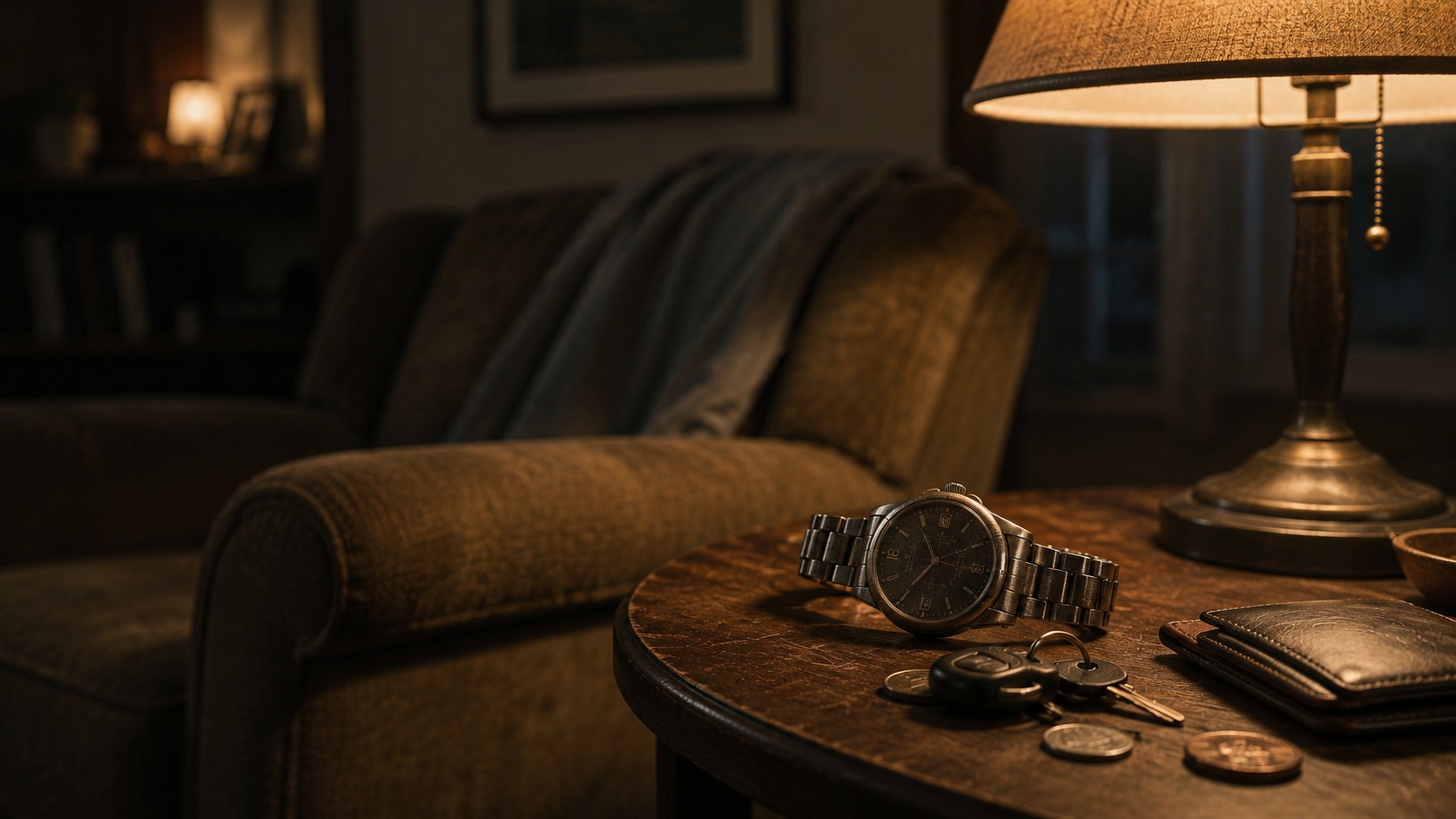
I’ve been thinking about Dad’s watch.
It was a Citizen watch, solar powered to some extent, and self-winding, or at least that is how I remember it. I do not know exactly how all the mechanisms worked together. I just know that Dad wore it for decades, and every evening when he took it off, he laid it under the lamp beside his chair.
That was part of the routine. He would come in, sit down, empty his pockets, take off the watch, and place it where the light could reach it. It was not treated like jewelry. It was not displayed like something expensive. It was just his watch, and it had a place.
There are some objects that become so attached to a person that they stop being objects by themselves. His watch was one of those. It was not just something he wore. It was part of the way he moved through the world. It went to work with him. It went to the farm with him. It went under hoods and around cattle and into town and back home again. It kept time through ordinary days, long days, good days, bad days, and days nobody thought much about at the time.
By the end, it was worn almost smooth. The back cover had been rubbed so much you could not read the writing anymore. Whatever had once been stamped into the metal was gone. It may have been paper thin for all I know. It had spent years against his wrist, and the evidence of that time had erased the evidence of the manufacturer.
I like that, in a way.
There was probably a model number on it once. There were probably words about water resistance and movement and stainless steel. But after enough years, none of that mattered as much as the fact that it was Dad’s. The official markings disappeared, but the meaning got clearer.
After he passed, the watch stayed there.
He passed in the morning, before he had a chance to put it on for the day. So the watch was not taken off for the last time in some dramatic way. It was not placed there as a memorial. It was not arranged carefully beside the lamp because anyone had decided it should become important.
It was simply where he had left it the night before.
That may be what makes it harder to think about.
He had taken it off like he always did. He had laid it under the lamp beside his chair, where the light could reach it. He probably expected, without thinking about it, to pick it up the next morning and put it back on his wrist. That is what routines are. They are small promises we make to tomorrow without realizing we are making them.
But tomorrow came, and he did not put the watch on.
So, it stayed there.
It lay under the lamp beside his chair for years. Not days. Not weeks. Years.
I do not remember anyone making a decision about it. Nobody announced that the watch would remain there. Nobody said, “We should leave that where Dad put it.” It simply stayed. The house adjusted around it. The chair was still the chair. The lamp was still the lamp. The watch was still under the lamp, as if it was waiting for him to come back in, sit down, and put it on again.
And apparently, for several years, no one moved it.
Then one day I noticed it was gone.
I do not know what happened to it.
Maybe Mom gave it to one of my brothers. Maybe she gave it to one of the grandkids. Maybe someone asked about it, and she thought it was time. But more than likely, she put it in a drawer somewhere because some things become too much to see every day.
I have never asked her.
I do not want to bring up bad times just to satisfy my curiosity. Grief has enough doors without me opening one that does not need to be opened. If she moved it, she had her reasons. If she gave it away, she had her reasons. If it is in a drawer somewhere, wrapped in a cloth or resting beside old keys and papers and things that no longer have a daily use, then maybe that is where it needs to be.
Still, I think about it.
Not because the watch was valuable in the way people usually mean valuable. I doubt it would be worth much to anyone else. It was too worn, too used, too ordinary. But that is how some things become valuable. They lose their resale value and gain something else entirely.
Dad has been gone almost six years now, and I still catch myself forgetting for a second.
I will be doing something and think, I need to call Dad and ask what he thinks about this. Or I will see something strange or funny or mechanical or unbelievable and think, There is no way Dad will believe this. I will reach for my phone, ready to take a picture and send it to him, and then I remember.
His phone does not exist anymore.
That is a strange thing to realize. Not just that a person is gone, but that the ordinary ways you reached them are gone too. You cannot call. You cannot text. You cannot send the picture. You cannot ask the question. You cannot hear the pause before the answer, or the little sound that meant he already knew what you were about to say.
And yet, in some ways, his number still exists.
Not long ago, we had to replace the starter on his truck. At the parts store, they asked for a phone number to look up the warranty. My brother and I looked at each other for a second, both of us trying to figure out which number it could possibly be under.
Then my brother turned and recited Dad’s number.
It was the one.
Their computer did not know he was gone. To the parts store, the record was still there. The name, the number, the purchase, the warranty. The system had not grieved. It had not adjusted. It had not sat in the chair and noticed the watch was missing. It simply held the information it had been given.
There was something comforting and heartbreaking about that.
Dad was gone, but his lifetime warranties were still there.
His lifetime was over, but some of the things attached to it had not expired.
That is the odd thing about losing someone. The world does not erase them all at once. Their things remain in layers. A watch under a lamp. A phone number in a parts store computer. A truck that still needs a starter. A chair that still looks like theirs. A drawer that may hold something too worn to read, but too meaningful to throw away.
We talk about a lifetime as if it belongs only to the person living it. But a lifetime spills over. It gets into tools, routines, phone numbers, recipes, habits, watches, and warranties. It leaves traces in places that do not understand what they are keeping.
That old watch spent decades gathering light so it could keep running.
Maybe that is why it stayed under the lamp so long after Dad was gone. Not because anyone believed it still needed charging, but because that was where it belonged. That was its place in the world. That was where Dad had put it.
And sometimes, after someone is gone, we leave things where they are because moving them feels too much like admitting what we already know.
I do not know where the watch is now.
I hope it is somewhere safe. I hope it is in a drawer, or with someone who understands what it is. I hope no one looks at it and sees only an old worn-out watch with a smooth back and a tired band.
Because it was more than that.
It was the watch Dad took off one evening, expecting to put it back on the next morning.
It was time Dad carried with him.
And for a while, it was time we could still see.