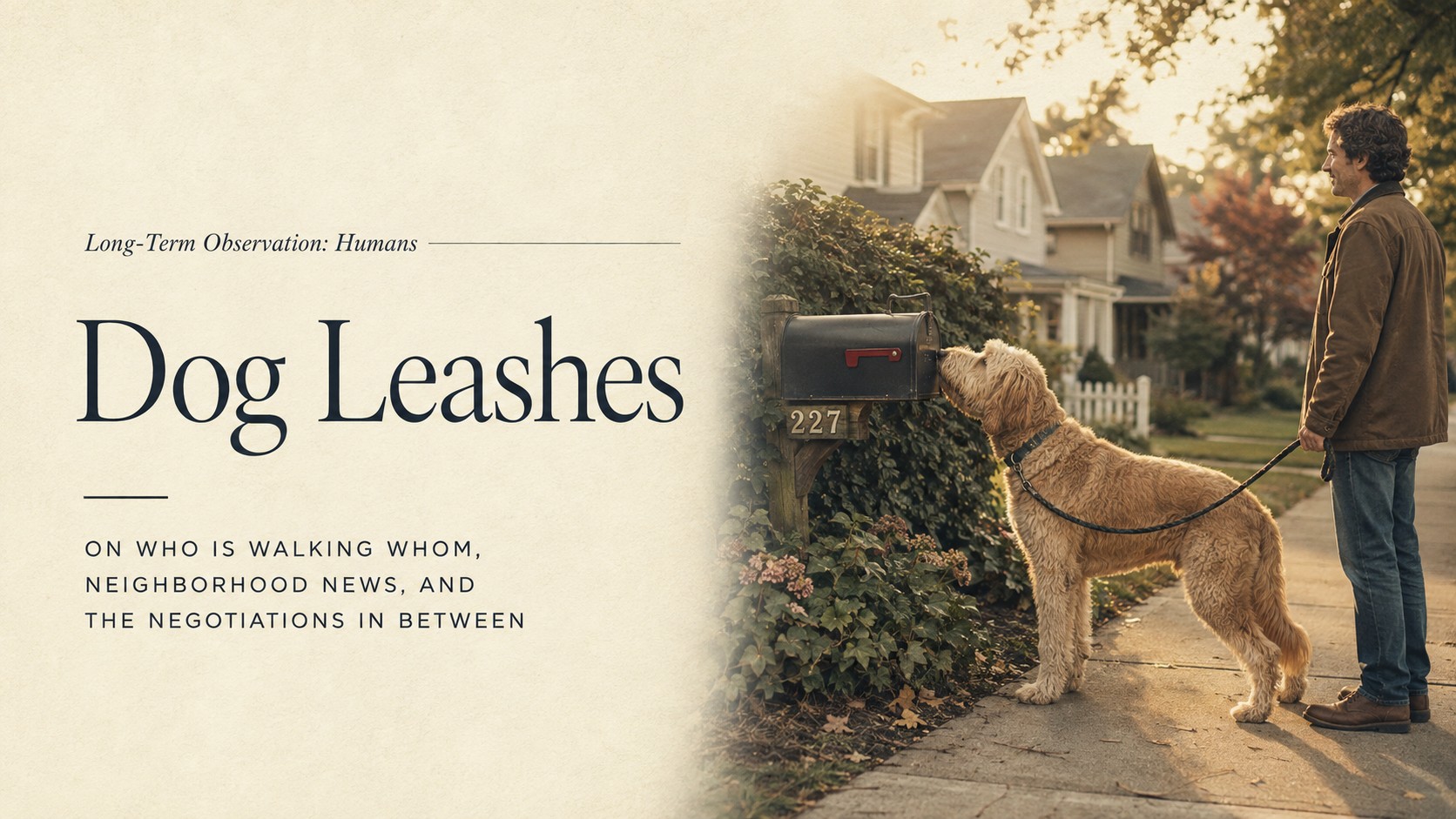
Dog leashes are an interesting invention. You know what I’m talking about; those nylon straps with a loop on one end and a snap hook on the other.
From a distance, they seem like pretty straightforward devices. One end attaches to the dog. The other end attaches to the human. The arrangement appears to make it abundantly clear who is in charge. However, big dog owners, little dog owners, and non-dog-owners usually have vastly different ideas on this.
The theory is simple, connect dog to human and they won’t be separated when they’re out.
The reality is a little more complicated. The leash guarantees we're attached. It makes no promises about who's making the decisions.
Most people will say, “I’m taking the dog for a walk.” And usually, that is actually the plan. However, as a big dog owner, I’m pretty sure the dog wouldn’t agree.
Human beings tend to walk with purpose. We leave the house intending to reach the corner, circle the block, or get a little exercise before dinner. Dogs seem to have a different objective entirely.
We have a hefty, 100-pound, lab mix. When he leaves the house, he intends to smell absolutely everything. Apparently, there are an awful lot of sniffs to sniff before you even get past the shrubs. I know he has sniffed that same shrub five times this week alone, but you don’t simply jiggle the leash and move a dog that big. He moves when he wants. Did I mention that he’s also solid muscle, so not only does he have the weight, but when he locks his legs and leans, you probably couldn’t move him with a truck until he’s ready. Then, suddenly, he’s ready to go. Not because I convinced him, but because he had finished whatever meeting he was attending.
Now, the mailbox requires inspection.
The tree by the mailbox also requires a TSA level inspection.
The fire hydrant demands considerably more attention than either of those.
By the time we're finished, I'm convinced he has a far better understanding of local events than anyone else on the block.
The patch of grass between the sidewalk and the curb apparently contains information of extraordinary importance.
Five minutes disappear while the leash grows tight and the human stands patiently waiting for an investigation that seems to have no foreseeable conclusion.
And then, without warning, the investigation is complete and we move on. I say, “We” as if it was a mutual decision. It was not. We’re moving on simply because whatever message had been left there by another dog has now been fully read.
The funny thing is that the arrangement doesn't work in reverse. I've never once seen a dog look back at the human and think, "They seem interested in this conversation. I'll give them another minute."
If the human stops to talk with a neighbor, the dog is patient for a moment or two, but only until the conversation becomes less interesting than the next smell drifting across the yard. Unless the neighbor happens to have a treat or particularly talented fingers for scratching behind the ears, the social visit is considered complete long before the humans have finished discussing the weather.
The leash doesn't really settle the question of who is leading whom. It merely ensures neither participant gets too far away while they negotiate.
The more I've watched dogs, the more I've become convinced that a walk isn't exercise from their perspective.
It's reading.
I suspect dogs would be baffled by the way we read newspapers. We skim headlines, glance at the weather, and move on with our day. They approach every mailbox post like an investigative journalist. They linger over details, revisit important passages, and occasionally add an editorial of their own before continuing down the sidewalk. From their perspective, I'm the impatient one, constantly trying to skip to the end of the article.
Every mailbox post, every utility pole, every corner of every shrub contains messages left by dogs that have already passed through. They stop, investigate carefully, add a few comments of their own, and continue to the next chapter. Judging by the amount of time he spends at certain mailbox posts, somebody in the neighborhood writes exceptionally long opinion pieces.
Meanwhile the human keeps glancing at a watch and wondering why it takes twenty minutes to travel a distance that could have been covered in four.
Maybe that's why I keep thinking about dog leashes.
Not because they're designed to control dogs, but because they quietly reveal that two creatures can travel the same path while believing they're pursuing entirely different goals.
The human thinks the walk is about exercise. The dog thinks it's about catching up on neighborhood events. Judging by how long we spend at the mailbox, I'm beginning to think the dog might be right.