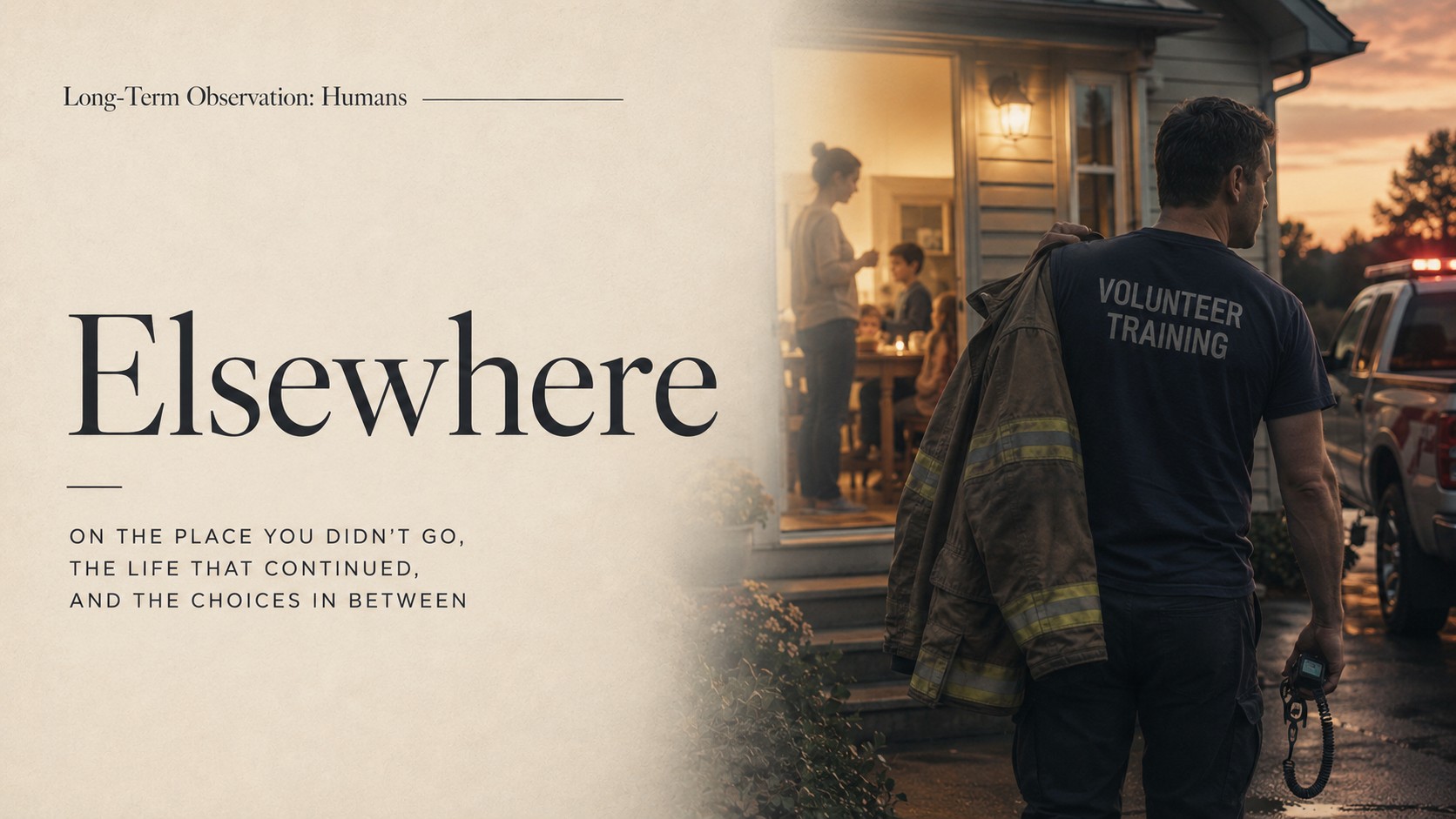
Every decision creates an elsewhere.
It isn't another life or an alternate timeline. It isn't the version of ourselves that accepted a different job, married a different person, or moved to another city. It is much simpler than that.
It is the ordinary place we didn't choose to be this afternoon.
The thought occurred to me one Thursday evening while driving to volunteer fire training. As I pulled into the station, my family was at home. Dinner was probably over. Someone was loading the dishwasher. Someone else was deciding what to watch on television. The dog was wandering from room to room hoping for a dropped piece of food. None of those things depended on me being there.
The evening continued exactly as it would have if I had never left the driveway.
If I had stayed home instead, another ordinary evening would have unfolded somewhere else. Firefighters would have gathered around the apparatus. Someone would have struggled to remember a radio procedure. Someone would have made the same joke he tells every month. A newer member would have learned something that might matter years from now on the side of a highway or in the hallway of a burning house.
That evening would have happened too.
The only difference is that I wouldn't have seen it.
For a long time, I thought decisions were primarily about priorities. I assumed every choice was an exercise in determining which obligation mattered more. Sometimes that's true. Emergencies demand immediate attention. Families deserve our presence. Employers expect reliability. There are moments when the correct decision is obvious.
Most of life isn't that simple.
More often, we choose between two perfectly reasonable places to be, knowing that whichever one we select will quietly continue while we are somewhere else.
Employment asks for our presence. Family asks for our presence. Churches schedule volunteer days. Children have concerts and baseball games. Friends get married. Parents grow older. Volunteer organizations hold meetings. Communities celebrate holidays. Every one of those systems develops its own calendar without consulting the others, and every so often they arrive at the same point in time.
The conflict isn't that one system is wrong.
The conflict is that there is only one of us.
When we attend the school concert, the meeting at work still happens. The presentation is given. Questions are asked. Someone tells a joke before everyone leaves the conference room. By the next morning, the conversation has already become part of the shared history of the people who were present.
When we stay late at the office instead, the concert still happens. The lights dim. The music begins. Parents applaud. Pictures are taken. A memory is created that will someday be described to us but can never quite be relived through someone else's words.
Neither event waits.
Neither pauses because we had another commitment.
The world is remarkably comfortable continuing in our absence.
At first that realization feels almost disappointing. We like to believe our participation is indispensable, that systems somehow pause until we arrive. In reality, they rarely do. Families adapt. Meetings begin. Churches sing the opening hymn. Fire departments stretch hose lines. Someone else drives the truck. Someone else takes notes. Someone else grills the hamburgers or unlocks the front door.
The systems keep moving.
That doesn't mean we aren't important.
It means the systems are larger than we are.
There is another consequence that becomes easier to recognize with time.
The places we don't choose continue creating memories that belong to our lives even though we never experienced them ourselves.
Our children laugh about something at dinner that we hear only secondhand. Coworkers develop an inside joke while we're on vacation. Friends tell stories around a campfire we couldn't attend. Fellow volunteers solve a problem and celebrate afterward while we're sitting in the bleachers watching a basketball game.
Those moments become part of our own story despite the fact that we were never there to witness them.
As we accumulate responsibilities, the number of these unseen moments grows. The more systems we participate in, the more pieces of our own lives unfold beyond the boundaries of our awareness. We don't lose them because we made poor decisions. We lose them because participation itself requires choosing.
No one can stand everywhere.
No one can witness every conversation, every celebration, every quiet evening around the dinner table, every joke told in the apparatus bay, or every meeting where something unexpectedly important happened.
Perhaps that is one of the hidden costs of belonging.
The more places that matter to us, the more parts of our own lives continue elsewhere.
We eventually return, of course.
The next morning someone says, "You should have been here yesterday."
A family member begins with, "You missed it."
A coworker summarizes the meeting in five minutes. A spouse retells a funny story from dinner. Someone forwards a picture or sends a text explaining what happened while we were gone.
We learn the facts.
We never recover the experience.
No explanation can recreate the timing, the expressions on people's faces, the laughter that interrupted the conversation, or the small details that made the moment meaningful to the people who actually lived it.
Reentry is always incomplete.
We can catch up on information.
We can never catch up on presence.
Every decision creates an elsewhere, and somewhere, while we were fully engaged in the place we chose to be, another ordinary piece of our own life became a memory without us.
That isn't failure.
It's simply the unavoidable consequence of belonging to more than one system at a time.