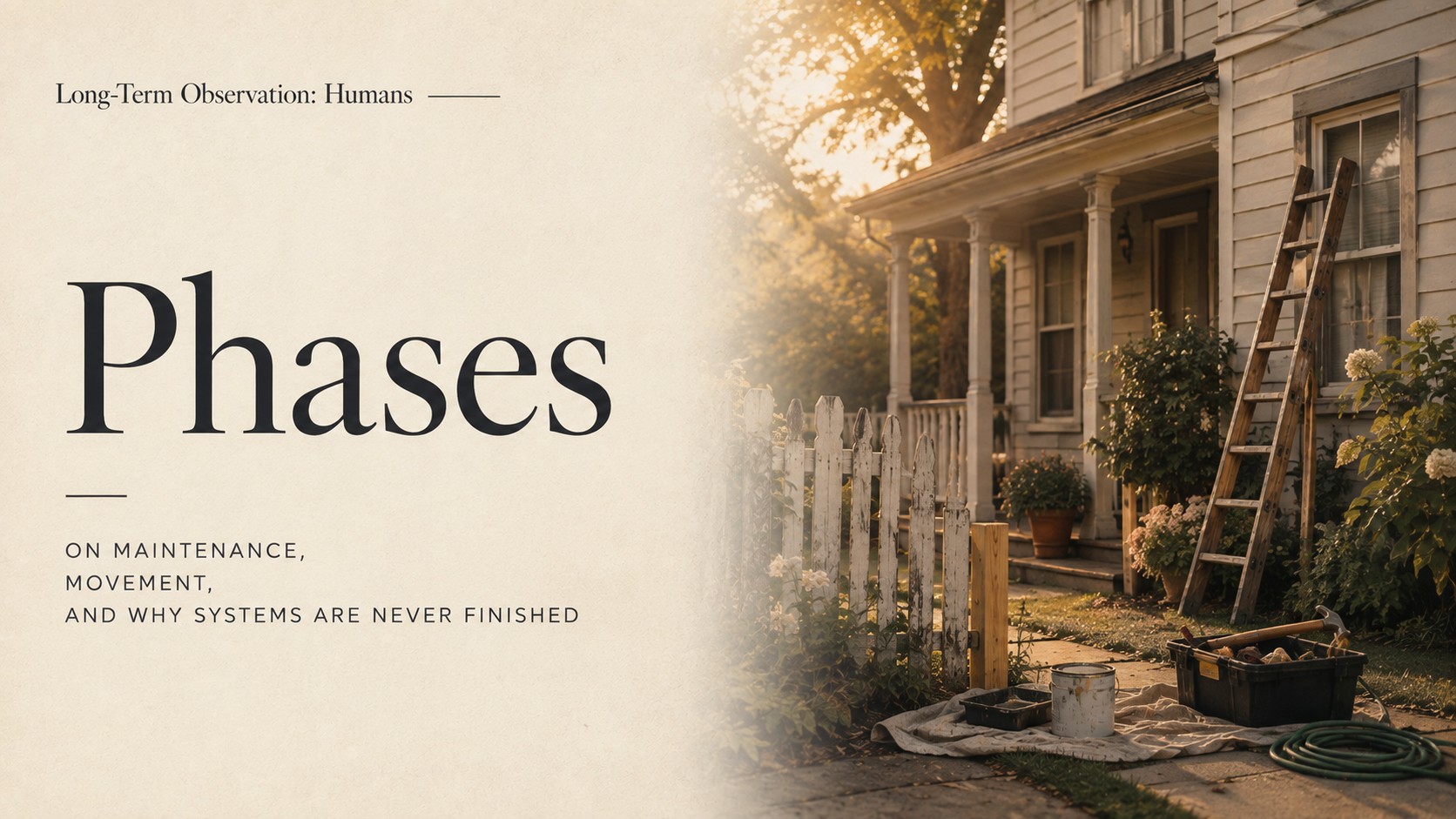
Anyone who has owned a house for very long eventually discovers that there is no such thing as being finished.
You replace the water heater and congratulate yourself on crossing another project off the list. A week later the garage door begins making a noise it didn't make before. Once that is repaired, a section of fence leans just enough to catch your attention. The gutters need cleaning again, a bedroom needs painting, and the faucet that was perfectly fine yesterday suddenly develops a slow drip.
For a while, this feels frustrating.
Eventually, you realize the house isn't failing.
It's simply continuing.
It took me longer than I'd like to admit to reach that conclusion. For years, every new repair felt like evidence that something was going wrong, as though I had somehow purchased the only house that couldn't stay finished. Eventually I realized the projects weren't interruptions to normal operation. They were normal operation. Houses are systems exposed to weather, time, gravity, and people. Living in one means participating in an endless cycle of maintenance, adaptation, and occasional surprise.
The same thing happens with almost every system we create.
We tend to imagine that systems have a destination. We build them to solve a problem, make a plan, write a procedure, or organize a group of people with the expectation that one day everything will settle into normal operation. We picture a point where the adjustments stop, the responsibilities stabilize, and the work becomes routine.
Most systems never actually arrive there.
Some only appear to because the people participating within them quietly absorb the changes required to keep them operating.
Even when a system seems stable, movement is happening beneath the surface. Equipment wears. Conditions evolve. New participants arrive while experienced ones leave. Technology changes. Expectations shift. Small adjustments are made that never appear in manuals or procedures because they happen naturally through experience.
What looks like consistency is often continuous correction happening quietly enough that no one notices.
Stability sometimes turns out to be movement small enough that we stop paying attention.
Over time, recognizable patterns begin to emerge.
Most systems experience some form of beginning, expansion, maturity, reinvention, or decline. The exact sequence differs from one organization to another but change itself is unavoidable.
Every system begins with startup.
A need exists, something is built to meet it. Roles remain flexible because no one is entirely certain what will be required. Problems are expected and quickly addressed because everyone recognizes the system is still finding its footing.
Growth follows naturally.
Very few systems begin operating at full capacity. New demands appear. Additional features are added. Responsibilities expand beyond what the original designers imagined. Procedures evolve to match reality instead of the assumptions made during planning.
The system becomes more capable.
It also becomes more complicated.
Eventually, participants begin describing the system as stable.
The word is comforting.
It is also misleading.
Nothing remains perfectly still for long. Components require maintenance. Processes are revised. Workarounds emerge. Participants develop habits that were never part of the original design. The system continues functioning only because countless small corrections occur every day, most of them without anyone consciously recognizing them.
What appears stable from the outside may simply be adaptation happening fast enough to keep pace with change.
Some systems eventually begin to decline.
The transition is rarely dramatic.
The original purpose becomes less aligned with current needs. More effort is spent preserving operation than improving it. Adjustments multiply. Workarounds become ordinary. Participants continue moving forward while quietly compensating for conditions they no longer expect to disappear.
Other systems never truly decline at all.
They reinvent themselves.
Businesses discover new markets. Volunteer organizations change their missions. Families reorganize after children grow up and leave home. The original system doesn't disappear so much as evolve into something its creators never anticipated.
And some systems simply end.
The need that created them disappears. Resources are exhausted. Participants move away. Shutdown arrives gradually or all at once, but in hindsight it often feels less surprising than it seemed at the moment.
No phase feels easy while we are living through it.
Startup feels uncertain because nothing has settled. Growth feels demanding because expectations expand faster than understanding. Stability carries the quiet responsibility of constant maintenance. Decline introduces hesitation even while outcomes still appear acceptable. Shutdown often feels final only after it has already occurred.
Recognizing a phase does not tell us what to do next.
Systems rarely announce where they are.
Growth can resemble stability. Stability can conceal decline. Reinvention often looks like disruption until enough time has passed to understand what actually happened. By the time we identify a phase with confidence, the system has usually continued moving and may already be becoming something else.
That is why the usefulness of recognizing phases is not prediction.
It is expectation.
We become less surprised when effort increases. We stop assuming that consistency means permanence. We begin to recognize maintenance as part of normal operation rather than evidence that something has gone wrong.
Most importantly, we stop expecting systems to become motionless.
Each of us participates in many systems at once, and they rarely move together. One may be beginning while another is ending. One may be growing while another quietly contracts. Their phases overlap, reinforce one another, and occasionally collide in ways that cannot be understood by examining either system in isolation.
The systems continue moving. So do we. The older I get, the more I suspect that much of adulthood is simply learning to stop mistaking movement for failure. We repaint houses, revise procedures, replace appliances, reorganize teams, and adjust expectations, all while quietly believing that next year things will finally settle down.
They rarely do.
Perhaps that is the greatest lesson phases have to offer.
The goal is not to predict exactly what comes next.
The goal is to recognize that change was always happening, even during the moments we were most convinced nothing was changing at all.