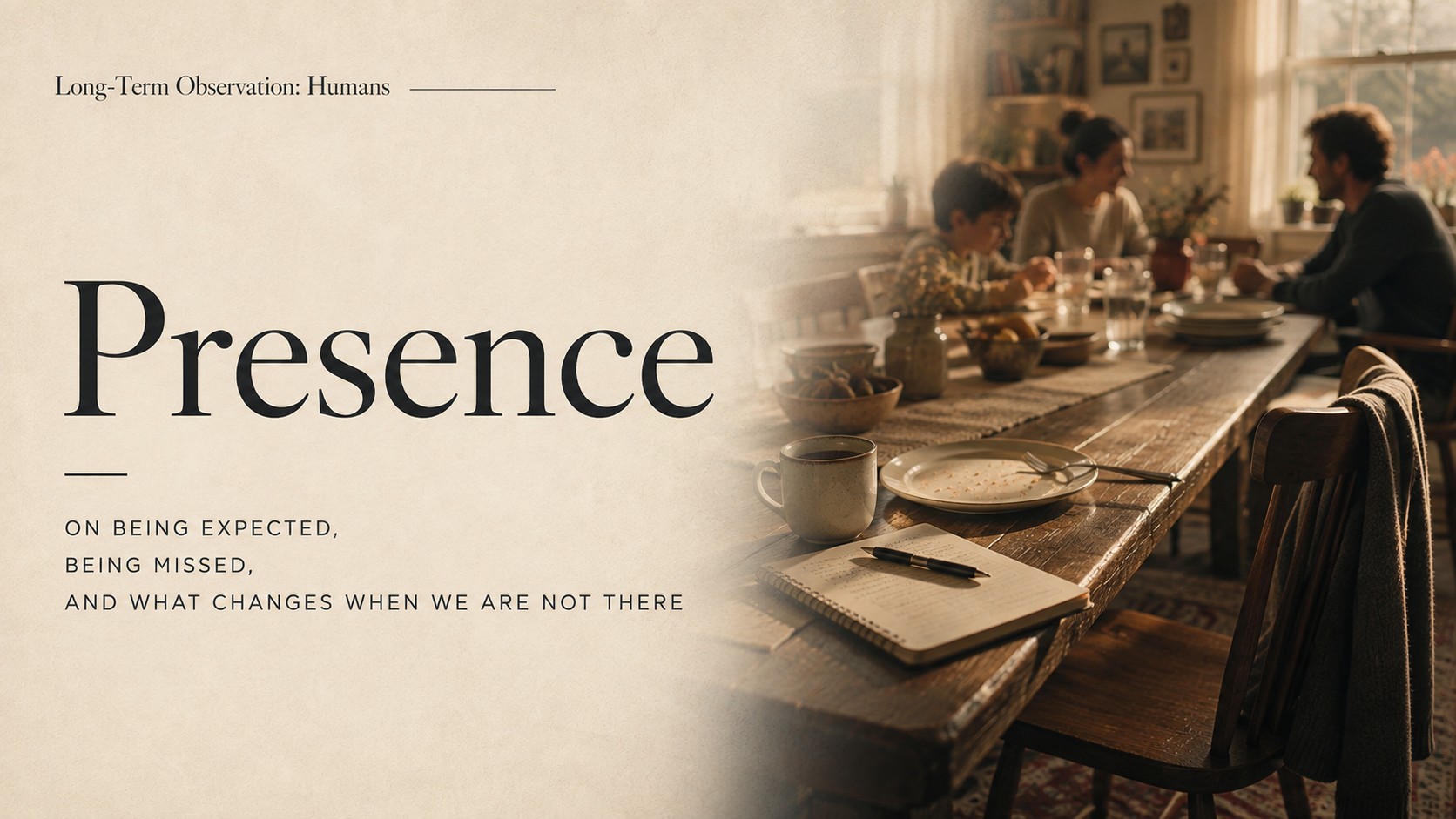
No one can be in two places at once.
The statement is so obvious that it hardly seems worth saying, yet much of the friction in our lives begins with pretending otherwise.
Every system quietly assumes our presence.
Our employer expects us to arrive at work. Our family expects us to come home for dinner. Friends expect us at birthdays and weddings. Churches schedule volunteers. Community organizations plan meetings. Schools invite parents to concerts and conferences. A volunteer fire department expects its members to answer the pager when help is needed.
None of those expectations are unreasonable.
They simply cannot all be satisfied at the same time.
We often think of time as our most limited resource, but time continues whether we make use of it or not. Presence is different. It can only be given once.
Every decision to be somewhere is also a decision not to be somewhere else.
A parent attends a child's basketball game and misses an evening meeting at work. A volunteer firefighter leaves the dinner table when the siren sounds. A manager stays late to finish a proposal while missing bedtime at home. A family postpones vacation because an aging parent suddenly needs help.
The choice may be easy or it may be agonizing, but it cannot be avoided.
Presence is finite.
The interesting part is that every system usually believes its own request is reasonable.
The employer isn't trying to interfere with the family. The family isn't trying to undermine the employer. The emergency isn't trying to disrupt dinner. Each system simply continues operating according to its own priorities and assumes the people within it will be available when needed.
Most of the time, they are.
The fault line appears when two systems arrive at the same moment with incompatible expectations.
Our first instinct is often to decide which system is right.
Sometimes that question has an obvious answer. A structure fire takes priority over mowing the lawn. A child's medical emergency takes priority over nearly everything else.
More often, however, there is no clearly correct choice.
Both commitments matter.
Both obligations are legitimate.
The conflict exists because our presence cannot be divided.
We sometimes imagine that choosing differently would have prevented the tension.
It rarely does.
Had we stayed at work instead of attending the recital, another fault line would have appeared somewhere else. Had we ignored the pager and remained at the dinner table, the absence would simply have shifted to another system.
The decision changes the location of the friction.
It does not eliminate it.
This is one reason experienced people often become less judgmental.
After participating in enough systems, we begin to recognize how frequently others are making impossible choices that remain invisible to us. The coworker who declined the meeting may have been caring for a parent. The volunteer who missed training may have been attending a graduation. The parent who arrived late may have been fulfilling an obligation elsewhere that no one in the room could see.
The absence tells us where someone isn't.
It tells us almost nothing about where they are.
Presence itself has value beyond the work being performed.
A child often sleeps more comfortably simply because a parent is sitting nearby. A new employee gains confidence when an experienced mentor is in the building. A meeting changes because someone with knowledge is available if questions arise, even if they never speak.
Sometimes the greatest contribution is not what someone does.
It is that they are there.
Which makes absence noticeable in unexpected ways.
A volunteer fire department may still have enough people to respond, yet everyone feels the missing driver who knows the roads by memory. An office functions during someone's vacation, but simple questions take longer to answer. A family gathering continues after the death of a grandparent, though no one can quite explain why it feels different.
Nothing has failed.
The system simply lost a presence around which other parts had organized themselves.
Because presence is limited, every commitment carries an opportunity cost.
We do not merely choose where to spend our time. We choose which systems receive our attention, our experience, our reassurance, and our availability. Those choices shape the systems around us in ways we rarely recognize while making them.
No one can be fully present everywhere.
The best we can do is recognize that every place we choose to stand creates an empty space somewhere else.
The hardest decisions in complex systems are rarely between right and wrong.
More often, they are between two places that both expected us to be there.