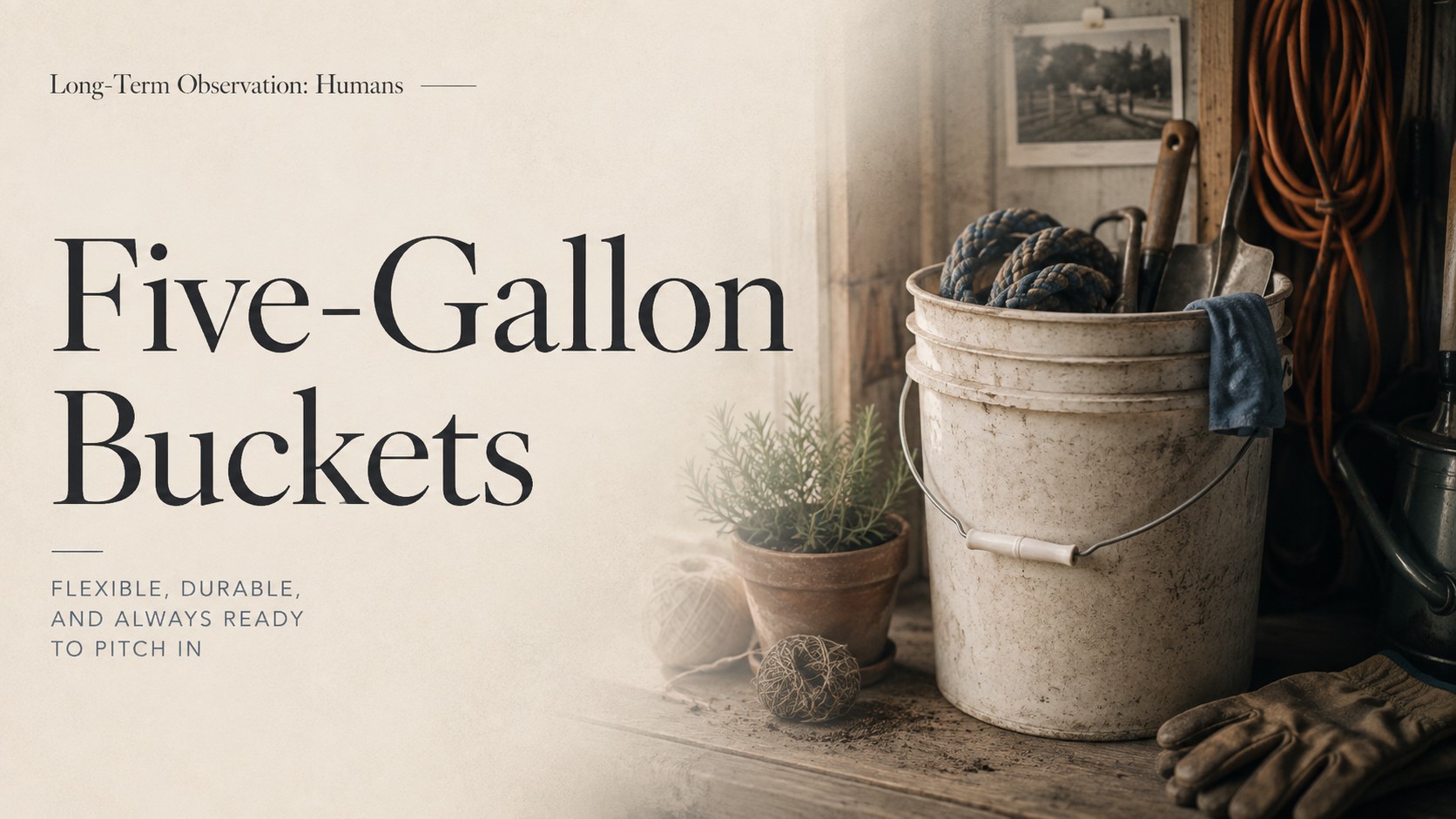
I've been thinking about buckets lately.
Not fancy buckets or decorative buckets. Just the ordinary five-gallon bucket you can buy at almost any hardware store for a few dollars. They come in orange, white, blue, black, and just about every other color imaginable. Some have company logos printed on the side. Others are completely plain. They all look remarkably similar, and somehow almost everyone seems to have at least one.
I honestly don't know who decided five gallons was the right size. Six seems better because more is better, until you try to carry it. Four gallons is easier to carry, but it somehow feels like not quite enough.
Some engineer or manufacturer somewhere had to make that decision, and I'd love to know how they arrived at it. Maybe they ran calculations. Maybe they built prototypes. Maybe they simply discovered through trial and error that anything smaller wasn't very useful and anything larger became awkward to carry.
Whatever the reason, they got surprisingly close to perfect.
I don't know what the first five-gallon bucket carried. Maybe paint. Maybe grain. Maybe nails or oil or water. It hardly matters anymore because the bucket quickly escaped whatever purpose it was originally intended to serve.
People buy them empty now.
Nobody walks into the hardware store saying, "I have absolutely no use for another bucket, but I suppose I'll buy one anyway." They buy it because they're about to plant tomatoes or wash the car or mix concrete. Then six months later that same bucket is holding Christmas lights in the garage, and nobody remembers what it was originally purchased for.
One might spend a week full of mulch before becoming a place to store extension cords. Another might haul chicken feed for years before ending up under a leaky pipe in the basement. I've seen them used to wash cars, catch roof leaks, organize tools, mix concrete, collect weeds, carry fish, store camping gear, and hold firewood kindling.
Sometimes they don't even hold anything at all.
Turn one upside down and it becomes a stool. Put a cushion on top and it becomes a seat. Flip it over at a campsite and it becomes a table. During a parade it becomes a place for a tired volunteer to rest for a few minutes. Hand a couple of sticks to a child and suddenly it's a drum.
They're stacked in garages, barns, workshops, sheds, and basements across the country because throwing one away somehow feels wasteful. Even when a bucket is too worn out for its original purpose, it usually finds another one.
In fact, they're so common that entire companies exist just to make accessories for them.
You can buy padded lids that turn them into comfortable seats. Tool organizers wrap around the outside. Dividers create storage compartments inside. There are wheeled dollies to roll them around the shop, snap-on trays for hardware, and even toilet seats designed to fit on top for camping or emergencies.
Someone looked at a bucket and decided it needed accessories. At some point we've stopped buying buckets alone and have started buying outfits for buckets.
That's remarkable.
The more I think about it, though, the less I believe the five-gallon bucket succeeded because it was perfect.
It's useful because it's flexible.
The best tools are often designed for one specific task. A paint roller paints. A shovel digs. A pipe wrench grips pipe. They're excellent at what they do and not particularly useful for much else.
The five-gallon bucket is different.
It asks almost nothing of the person using it. Fill it. Empty it. Sit on it. Stand on it. Store it in the corner for six months until another problem appears. It doesn't complain if the contents change from water to screws to tomatoes to firewood kindling. It simply accepts whatever job comes next.
Maybe that's why almost everyone owns one.
Not because they know exactly what they'll use it for, but because experience has taught them that eventually they'll find a reason.
The five-gallon bucket wasn't optimized to be the world's best paint container or the perfect gardening tool or the ideal workshop organizer. It became indispensable by being good enough at all of them.
And the older I get, the more I wonder if that's true of people, too.
We spend a lot of time admiring specialists, and rightly so. There is real value in mastering a single craft. But the people who quietly hold families together, keep organizations running, and solve unexpected problems often have something else entirely. They aren't necessarily the best at one thing. They're simply willing to carry whatever happens to be handed to them.
Maybe that's what made the bucket so successful.
It isn't exceptional because it's perfect.
It's exceptional because it's useful.
The five-gallon bucket never argues with the job it's given.