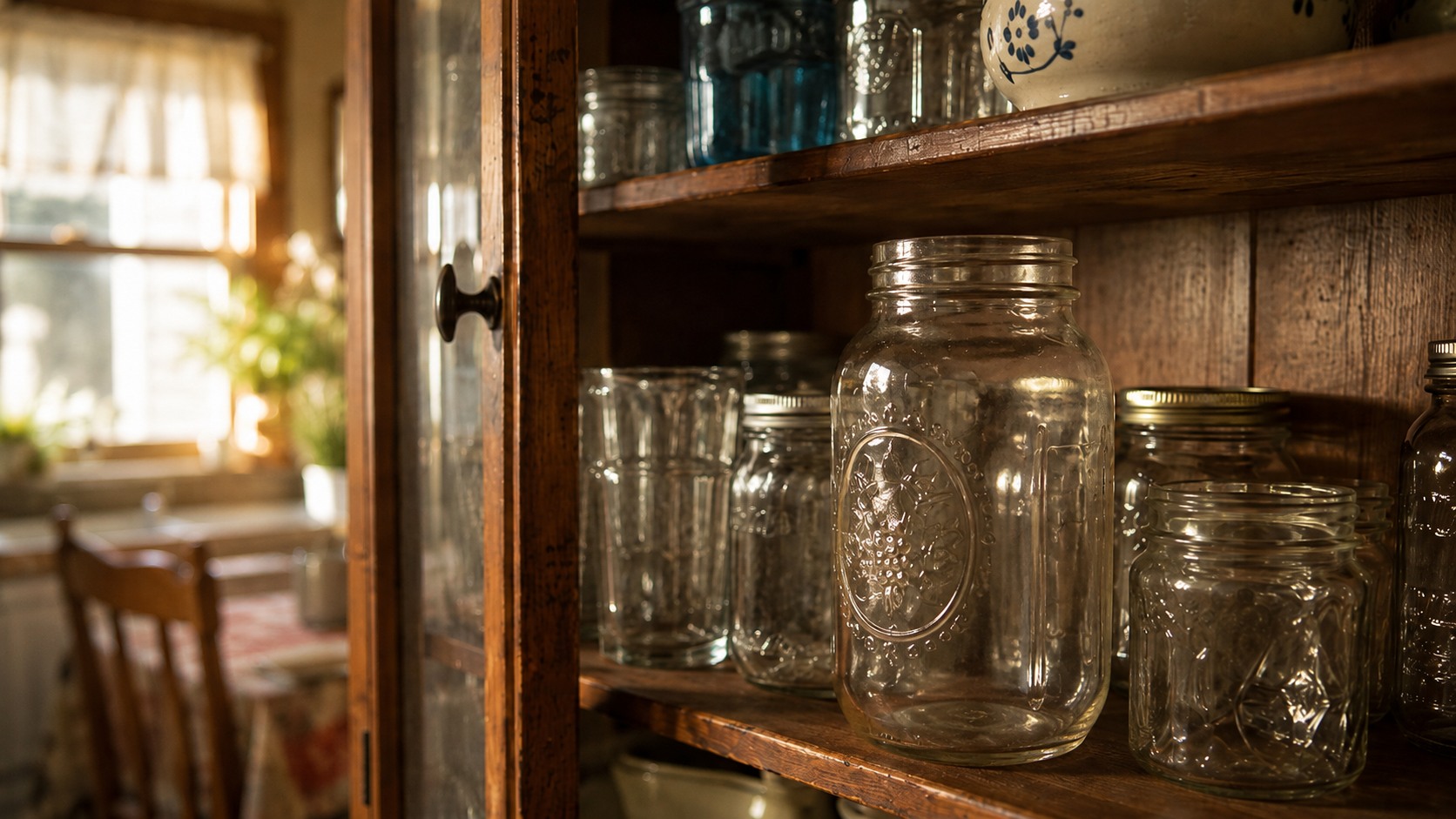
I’ve been remembering the mason jars in Mom’s glass cabinet.
Not just mason jars in general, though I have always liked them. I mean those jars specifically. The ones sitting in the cabinet with the other glassware, ordinary enough to use but old enough to feel like they belonged to another time.
They were not displayed like antiques exactly. At least, that is not how I remember them. They were just there, part of the house, part of the cabinet, part of the quiet evidence that some things were kept because they still had use in them and some things were kept because they had already carried too much to throw away.
That is one of the things I remember about Mom’s house. Useful things and memory things were not always separate categories.
When I was little, mason jars were mixed in with the glasses. So were jelly jars. They weren’t displayed that way on purpose. Nobody arranged them to create a rustic farmhouse look before people started trying to create rustic farmhouse looks. They were just there because that was what we had.
The little jelly jars were for kids.
They were the right size for small hands, and if one got broken, nobody acted like a family heirloom had been destroyed. A jelly jar was a glass with a second life. It had already done its first job. It had held jelly, jam, preserves, or something else sweet enough to make breakfast better. After that, it was washed, saved, and promoted to the cabinet.
There is something satisfying about that kind of promotion.
A jar did not become useless just because the jelly was gone. It still had shape. It still had strength. It still had a mouth wide enough to drink from and glass thick enough to survive ordinary childhood. So into the cabinet it went, beside the regular glasses, waiting for milk, tea, water, Kool-Aid, or whatever else a child needed.
Nobody had to explain reuse as a virtue then. It was just how a house worked.
The mason jars were for bigger thirsts.
Sometimes even the biggest regular glass wasn’t enough. Sometimes you had been outside, running, playing, working, sweating, or just being a kid hard enough that twelve ounces of anything seemed like a suggestion. That was when you needed a quart jar. Water, tea, Kool-Aid, lemonade, whatever was available. It didn’t matter much. The important thing was that the jar held enough.
A quart mason jar fit in your hand just right. It was big, but not awkward. It had weight without feeling clumsy. The raised lettering gave you something to grip, especially when the outside of the jar started sweating. It felt honest in a way some glasses don’t. It wasn’t delicate. It wasn’t trying to impress anyone. It was made to hold something and not let go.
That may be why I still like them.
A mason jar is not pretending to be more refined than it is. It does not have thin edges or elegant lines. It does not belong in a formal place setting, unless the formal place setting has already given up and decided to enjoy itself. A mason jar is practical glass. It was made to be filled, sealed, stored, carried, opened, washed, and used again.
It was working glass before it became decorative.
That is the difference I want my children and grandchildren to understand. Mason jars were not always centerpieces, candle holders, craft projects, flower vases, or expensive drinking glasses sold new to look old. They were not trying to look rustic. They were not trying to create a mood.
They were just jars.
They held vegetables, preserves, jelly, soup beans, pickles, tomatoes, buttons, grease, nails, coins, bacon drippings, and whatever else needed a place to stay. They sat in cabinets, pantries, refrigerators, sheds, and windowsills. They were too useful to throw away and too common to think much about.
That is how a lot of memory hides.
Not in the fancy things. Not always in the china, the photographs, the certificates, or the pieces people know to protect. Sometimes memory hides in the things everybody used without thinking. The glass beside the sink. The jar in the cabinet. The one on the shelf that nobody calls special until years later, when suddenly it is.
I have plenty of glasses now.
That may be part of what surprised me when I noticed what was missing. It isn’t like we are drinking out of cupped hands. My cabinet has regular glasses, coffee cups, insulated cups, and travel mugs large enough to make a quart jar seem reasonable. Some of those travel mugs hold more than any mason jar we ever used. They keep drinks cold for hours, fit in cup holders, have lids that mostly work, and cost more than an entire shelf of jelly jars would have cost when I was a kid.
I also have small glasses that all match.
They work fine for the grandkids. They are the right size, and they look like they belong with the rest of the cabinet. Nobody has to drink milk out of a jelly jar unless they want to. Nobody has to wonder whether the glass once held grape jelly, apple butter, or strawberry preserves. Everything has become more intentional, more coordinated, and probably a little more boring.
But there are no mason jars.
Not in my glass cabinet.
I suppose that makes sense. I don’t can anything anymore. I don’t put up vegetables, make jelly, or fill shelves with tomatoes, beans, pickles, or preserves. Jars used to arrive through use. They came into the house full and stayed after they were emptied. You didn’t have to go looking for them because life produced them. The kitchen absorbed them. The cabinet made room.
Now, if I wanted mason jars, I would probably have to go buy a flat of them.
That feels wrong somehow.
Not morally wrong. Just backward.
Mason jars are supposed to come into a house as part of living. They are supposed to arrive full of something. They are supposed to be opened, emptied, washed, and saved because throwing them away would feel careless. Buying them new just to make the cabinet look older seems like trying to purchase a memory instead of inheriting one.
But Mom’s cabinet still has them.
That is the part that matters to me.
Somewhere in her house, among the glasses and dishes and all the other things that have found their place over the years, there are still mason jars and jelly jars. Maybe nobody uses them much anymore. Maybe they sit farther back than they used to. Maybe they are not part of daily life the way they once were. But they are there.
There is comfort in that.
The jars in Mom’s glass cabinet are not rare. They are not fancy. They are not the kind of thing someone would usually list carefully or wrap in tissue paper. They are not valuable in the way people usually mean valuable. But they connect to a way of living that is easy to lose if no one says it out loud.
They remind me that houses used to keep useful things.
They remind me that a jar could finish one job and still have another one waiting.
They remind me that kids drank out of jelly jars because jelly jars were the right size and because nobody needed every glass in the cabinet to match.
They remind me that a quart jar full of tea or water could feel like exactly what a hot afternoon required.
They remind me that Mom’s house still holds some of the ordinary evidence of how we lived.
That is why I want to write about them here.
My children and grandchildren may see a mason jar now and think of sweet tea at a restaurant, flowers at a wedding, candles on a porch, or something bought new at a store to look old. There is nothing wrong with any of that. A useful thing is allowed to become beautiful too.
But I want them to know that, in our family, mason jars were not decoration first.
They were working glass.
They were part of how people kept things.
They were part of kitchens where waste was avoided because something that still had use left in it was not finished yet. They were part of cabinets where nothing had to match perfectly to belong. They were part of a world where ordinary things moved from one purpose to another without anyone needing to make a speech about it.
Maybe that is the part I miss.
Not just the jars.
The assumption behind them.
The assumption that things could be reused. That usefulness mattered. That a container could have a second life. That a little jelly jar could become a child’s glass. That a quart jar could become the answer to thirst. That a cabinet could hold a mixture of new, old, matched, mismatched, bought, saved, inherited, and reused things without anyone feeling the need to apologize for it.
A cabinet like that tells a different kind of story.
A modern cabinet may tell you what someone bought. Mom’s glass cabinet tells me what the house kept.
There is a difference.
One day, when the time comes to distribute Mom’s things, maybe I will be lucky enough to get one of those jars. Maybe one of the jelly jars will find its way into my cabinet. Maybe a quart jar from the top shelf will sit behind my glasses and wait there too.
I hope that day is a long time from now.
For now, I am glad I know where they are.
That may be the strange thing about ordinary objects. We don’t always miss them when they leave. Sometimes we only notice the absence years later, while reaching for something else. A cabinet looks full. The shelves aren’t empty. There are plenty of glasses. Nothing is technically missing.
And then, suddenly, something is.
Not something expensive. Not something fragile. Not something anyone would think to protect because of what it would bring at a sale. Just a jelly jar. Just a quart mason jar. Just the kind of thing that used to appear in cabinets because families reused what they had, and because childhood thirst sometimes required more than a regular glass could provide.
I don’t need a mason jar.
That is probably the truth of it. I have better cups now. Bigger cups. Cleaner cups. Cups with lids and insulation and matching sets. I have everything I need to drink from.
But need isn’t the only reason we keep things.
Sometimes we keep things because they remind us of how a house used to work. Sometimes we keep them because they still fit the hand. Sometimes we keep them because the raised letters, the heavy glass, and the slightly awkward rim can bring back a whole kitchen without warning.
Maybe that is why the jars in Mom’s glass cabinet stay with me.
They are not just jars.
They are proof that ordinary things can carry family history without anyone asking them to. They are proof that a cabinet can become an archive. They are proof that usefulness and memory can live on the same shelf.
So I want my children and grandchildren to know about them.
I want them to know there were mason jars in Mom’s glass cabinet. I want them to know those jars belonged to a world where people saved containers, reused what they had, canned what they grew, and kept small useful things because small useful things mattered.
I want them to know that not everything worth keeping looks important.
And I want them to know that sometimes memory is stored in the plainest glass.
My cabinet doesn’t have any mason jars in it.
Mom’s still does.
And for now, that is enough.