Every house has scissors, but not every pair of scissors matters. Some scissors live in junk drawers and spend their lives cutting coupons, school paper, tape, string, and things they were never meant to cut. Some are kitchen scissors. Some are office scissors. Some are the old ones in the toolbox that may or may not still work, depending on what somebody used them for last.
But Mom had good scissors.
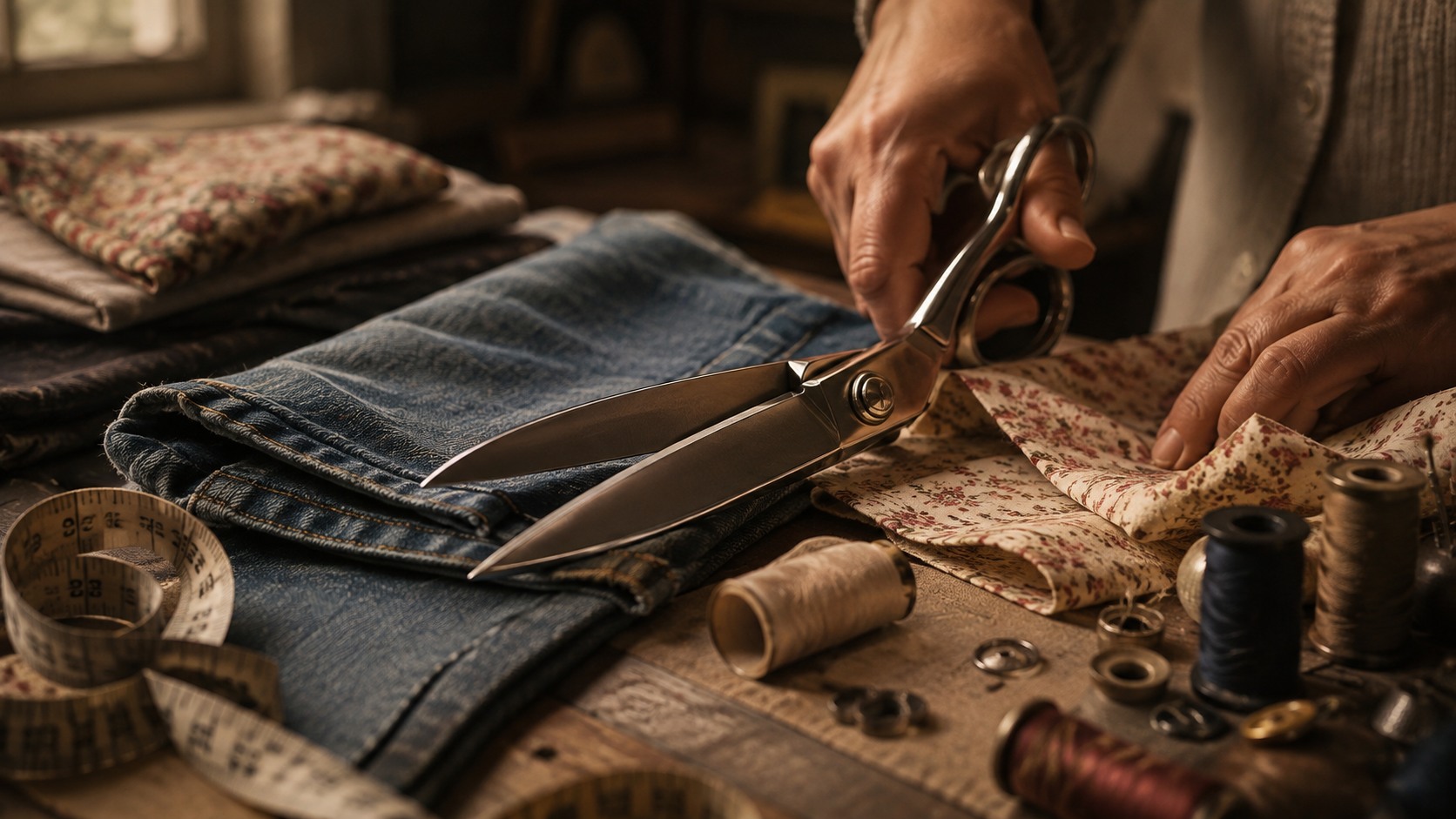
They were not the orange-handled plastic kind most people picture now. These were polished stainless steel, bright enough to catch the light and heavy enough that they felt like they belonged in an adult’s hand. They probably weighed over a pound, or at least they felt that way to a child. They had an incredible shine to them, the kind of shine that made them seem important before anyone ever explained the rule.
And the rule was simple.
We were not allowed to touch them.
Actually, that may not be strong enough. We were specifically forbidden to touch them unless the purpose was to bring them to Mom. If Mom asked for the good scissors, you could pick them up carefully, carry them directly to her, and hand them over like you were delivering something important.
Because you were.
We were told they could cut your fingers off.
That may have been a little dramatic, but not by much. To a child, those scissors looked capable of it. They were heavy, polished, sharp, and serious-looking, with blades that seemed less like something from a sewing basket and more like something from a shop or an operating room. They did not look like something a child should casually pick up and experiment with.
But the warning was not only about safety.
They had to stay that sharp because Mom needed them for her work.
That was the part we understood, even if we did not fully appreciate it. Those scissors were not for convenience. They were not the pair you grabbed because they happened to be nearby. They were not for opening boxes, cutting cardboard, trimming paper, slicing through tape, or helping finish a school project at the kitchen table.
Those scissors were for fabric.
That was their calling.
And they were magnificent at it.
I can still remember the sound they made cutting through fabric. It was not the ragged chewing sound of dull scissors fighting their way through paper. It was not the thin little snip of ordinary scissors. It was smooth and clean and confident, almost musical in its own practical way. The blades would open and close with that deep, satisfying sound, and the fabric would simply separate as if it had been waiting for permission.
Blue jean hems, fine damask, lace, cotton, regular fabric, heavy fabric, delicate fabric — it did not seem to matter. If Mom wanted to cut it, those scissors would cut it.
That may be one of the first things I understood about good tools. A good tool does not make the work effortless, exactly, but it removes a certain kind of struggle. It lets skill do what skill already knows how to do. Mom knew how to sew. She knew how to measure, pin, cut, piece together, hem, repair, and make something useful or beautiful out of flat material. The scissors did not give her that ability, but they served it.
They were worthy of the work.
That is probably why she protected them.
At the time, I doubt I thought of it that way. As a child, a rule is just a rule. Do not touch the good scissors. Do not run in the house. Do not slam the screen door. Do not leave the freezer open. Do not use Mom’s sewing scissors.
But looking back, I understand.
Those scissors were not protected only because they were sharp enough to be dangerous, though they were. They were protected because they mattered. They had a job, and their ability to do that job depended on people not misusing them. One child cutting cardboard or tape might not ruin them immediately, but it would start something. A little dulling. A little residue. A little disrespect. A little forgetting what they were for.
And good scissors only stay good if someone remembers.
That may have been the real lesson, though I did not know it then. Some things in a house are common property, and some things are entrusted to the person who knows what they are for. Mom’s scissors belonged to Mom because Mom understood them. She knew what they could do, what they should do, and what they should never be asked to do.
There was authority in that.
Not harsh authority. Just the authority of someone who knew her work.
When Mom sat down with fabric and those scissors, there was a kind of order to it. Fabric was not just cloth. It was material waiting to become something. A dress. A curtain. A repair. A costume. A hem. A project. A solution. Something useful. Something needed. Something made by hand because buying it was not always the answer, and because making things was one of the ways people took care of a family.
Those scissors were part of that.
They were there for the fabric store years. They were there for sewing projects. They were there for alterations and repairs. They were there when material had to be measured and cut correctly the first time, because fabric does not forgive careless cutting the way paper sometimes does. Once the scissors close, the decision has been made.
Maybe that is why the sound stays with me.
I do not remember every project Mom made with those scissors. I do not remember every piece of fabric she cut. But I remember that sound. I remember the confidence of it. I remember the way the fabric fell away from the blades in a clean line. I remember knowing that I was watching something I was not allowed to interrupt.
Children do not always know when they are being taught respect.
Sometimes they think they are only being told no.
But “no” can be a form of instruction. No, you may not use these on paper. No, you may not use these because they are convenient. No, you may not treat a good tool like any other tool just because you need something cut. No, you may not take what someone else depends on and use it carelessly.
That is not just a sewing rule.
That is a life rule.
Good tools deserve respect. So do the people who know how to use them.
I have owned a lot of tools since then. Mechanic’s tools, construction tools, electrical tools, woodworking tools, tire tools, farm tools, fire service tools. I have learned the difference between a tool that sort of works and a tool that does exactly what it is supposed to do. I have learned why people get particular about who uses their tools and how they are used. I have learned why a person can sound unreasonable about something that seems ordinary to everyone else.
Because sometimes the thing being protected is not just the tool.
It is the work.
It is the skill.
It is the frustration of needing something sharp and finding out someone dulled it on cardboard. It is the memory of saving up for something good. It is the quiet pride of having the right tool for the job. It is the knowledge that a careless person can damage in five minutes what a careful person preserved for years.
Looking back, I understand the rule better now.
Mom was not just protecting a pair of scissors. She was protecting the sharpness her work depended on. She was protecting the tool that let her cut fabric cleanly, accurately, and without fighting it. One careless use might not have ruined them forever, but it would have taken something from them. A little sharpness. A little smoothness. A little of the clean sound they made when they were doing exactly what they were made to do.
That is a different kind of respect.
Children hear, “Do not touch that.”
Adults eventually understand, “This matters because someone depends on it.”
That is what Mom’s good scissors taught me.
At least, that is what I think they taught me now.
Back then, they were just the scissors we were not allowed to touch. They were heavy, polished, sharp, and slightly mysterious. They caught the light like something more valuable than scissors had any right to be. They belonged to Mom in a way few household items clearly belonged to anyone. If she asked for them, we could carry them to her. Otherwise, we left them alone.
And when she used them, they made that sound.
That clean, heavy, wonderful sound of sharp steel moving through fabric.
I can still hear it.
I can still see the fabric opening.
I can still feel the seriousness of being trusted to carry them across the room and hand them to her without turning them into something common.
Maybe that is why I remember them.
Not because they were scissors.
Because they were Mom’s scissors.
Because they were part of the work she knew how to do.
Because they were one of the first ordinary things that taught me some things are not valuable because they are rare or expensive. Some things are valuable because the right person uses them well, protects them carefully, and teaches everyone else, whether they understand it or not, that usefulness deserves respect.