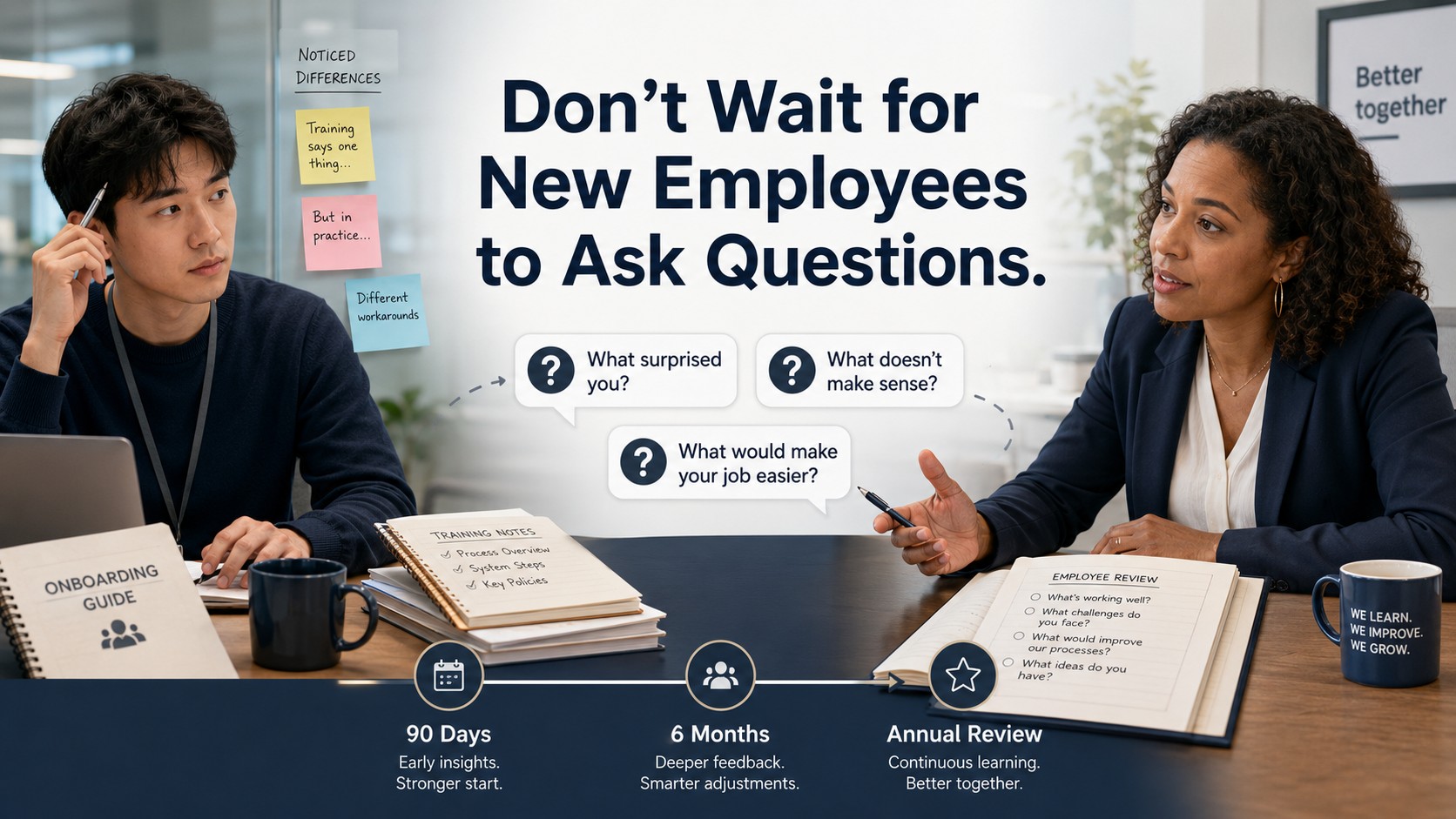
There is a limited window to learn from new employees.
During the first few weeks, new employees are often too overwhelmed to know which questions to ask. They are learning names, responsibilities, systems, processes, customers, acronyms, expectations, and dozens of small details everyone else stopped noticing years ago. Even when something does not make sense, they may reasonably assume the problem is their own lack of understanding.
They may also be reluctant to say anything. No one wants to begin a new job by telling experienced coworkers that the procedure seems wrong, the training contradicts what people actually do, or a process appears unnecessarily complicated.
But that changes surprisingly quickly.
After several months, employees begin to adapt. They learn the shortcuts and unwritten rules: which procedures are followed literally, who actually needs to approve something, and whom to ask when the documented process does not work. Inconsistencies that stood out at first begin to seem normal.
That leaves a relatively short period when a new employee knows enough to recognize that something does not make sense but has not been there long enough to stop noticing it.
We should use that time wisely.
And that means we should not wait for new employees to ask questions.
“Do You Have Any Questions?” Is Not Enough
Most managers ask new employees if they have questions. The problem is that the question places all of the responsibility on the person who knows the least about the organization.
To ask a useful question, employees must first recognize that something is unusual. Then they must decide whether they understand enough to challenge it, identify someone safe to ask, find the right time, and weigh the answer against the risk of seeming inexperienced, difficult, or critical.
It is much easier to say, “No, I think I’m good.”
If we actually want useful information, we must ask better questions.
What have you been told to do that does not match what you have seen people actually do?
Where have two people given you different instructions?
What part of the process has been harder to understand than it should be?
What have coworkers taught you informally that was never covered in your training?
What procedure seemed straightforward when you read it but works differently in practice?
These questions do something important. They give the employee permission to identify an inconsistency without requiring them to diagnose it.
A new employee should not have to tell us, “Your process is wrong.” They may not know whether the process is wrong. They may be missing context. There may be a legal, contractual, financial, safety, or quality reason for doing something that is not yet obvious to them.
What we want them to be able to say is, “The procedure says this, but I have seen us do that. What am I missing?”
Then it becomes our job to determine whether they are missing something—or whether they have just found something the rest of us have learned not to see.
We Already Have a 90-Day Opportunity
Many organizations already have a natural point for this conversation: the 90-day review.
But most 90-day evaluations are designed almost entirely to answer one question:
How is the employee doing?
Is the employee meeting expectations? Are they learning quickly enough? Are there performance concerns? Do they understand their responsibilities? Are they fitting into the team?
Those are reasonable questions. The organization needs to know whether a new employee is succeeding.
But the 90-day review could also ask another question:
What has the employee learned about us?
By then, employees usually know enough about the job to recognize patterns. They have probably encountered procedures that do not match practice, unclear ownership between functions, conflicting instructions, unnecessary steps, undocumented shortcuts, or assumptions that were obvious to everyone except the newest person in the room.
That information has value.
Instead of using the entire evaluation to assess the employee, part of the conversation could assess the employee’s experience with the organization.
What surprised you?
What was harder to learn than it should have been?
Where did our training not match the way the work is actually performed?
What question did you have during your first month that you eventually stopped asking?
That last question may be especially useful. Sometimes the fact that an employee no longer has a question does not mean we answered it. It may mean they learned how to operate around it.
Six Months Tells Us Something Different
Many organizations also conduct a six-month review. That is not necessarily too late to ask these questions, but the answers may have changed.
At 90 days, we can ask what still looks inconsistent.
At six months, we can ask what the employee has learned to live with.
The same basic questions can be repeated because the differences between the answers may tell us as much as the answers themselves.
Something that confused an employee at 90 days may make sense at six months once they understand why the process exists. That is useful information: the process may be sound, but the training may not have explained its purpose clearly enough.
Something else may have disappeared from their list because they simply learned the workaround.
That is useful information too.
Ask what confused them at 90 days but makes sense now. Ask what still does not make sense, what they have learned to work around, what they now do differently from the written process, and what seemed strange at first but now feels normal.
And perhaps ask the simplest question of all:
If someone started tomorrow, what would you explain to them that no one explained to you?
The answer may reveal the unofficial operating manual that experienced employees carry around in their heads.
Then Keep Asking
There is no reason these questions should disappear once an employee is no longer new.
Annual performance reviews often focus on accomplishments, goals, development plans, strengths, weaknesses, career aspirations, and where employees hope to be in three or five years.
Again, those are legitimate topics.
But we spend a great deal of time during employee reviews asking what the employee should do better and relatively little time asking what the organization could do better.
An annual review could include a few very different questions.
What are we making harder than it needs to be?
What process wastes your time without adding enough value?
Where do responsibilities or approvals become unclear?
What problem does your team repeatedly solve instead of eliminating?
What do we say is important but behave as though it is not?
Those questions will not always produce comfortable—or even correct—answers. Employees see the organization from their own positions and may not know all the reasons behind a requirement or decision.
But that does not make the observation useless.
If several people independently identify the same friction point, workaround, communication problem, or contradiction, the organization has learned something worth examining.
The Hard Part Comes After the Question
There may be another reason organizations do not ask these questions very often.
Answers create work.
If an employee says an approval process regularly delays routine decisions, we now have something to investigate. If someone says a written procedure is routinely ignored, we must determine whether the procedure should change or the practice should stop. If several employees report that information consistently gets lost between two functions, someone may need to redesign how those functions interact.
It is easier not to know.
Perhaps organizations do not avoid these questions because they are afraid of criticism. Sometimes the harder problem is that once we ask, we have to decide what to do with the answer.
That does not mean every suggestion requires a change. Asking employees what is not working is not the same as putting organizational design to a popular vote. Some controls are inconvenient because of the risks they manage. Some procedures exist for reasons employees cannot see from their individual roles. Sometimes the right response is to explain a process more clearly rather than change it.
But we should at least be willing to examine the answer.
Otherwise, asking for feedback becomes another organizational ritual: something we say we value without creating any expectation that it will affect anything.
Use the Perspective Before It Disappears
New employees possess something experienced employees gradually lose: the ability to see the organization without automatically accepting all of its assumptions.
They do not necessarily know how to fix what they see. They should not be expected to. They may not even know whether what they are seeing is actually wrong.
But for a brief period, they can still see things that the rest of us have learned to navigate without thinking.
At 90 days, ask what does not make sense.
At six months, ask what they have learned to work around.
At the annual review, ask what the organization could do better.
Then listen carefully to the answers.
Employee evaluations should tell us how employees are doing. But if we use them well, they can also tell us something about how the organization is doing.
We just have to ask.