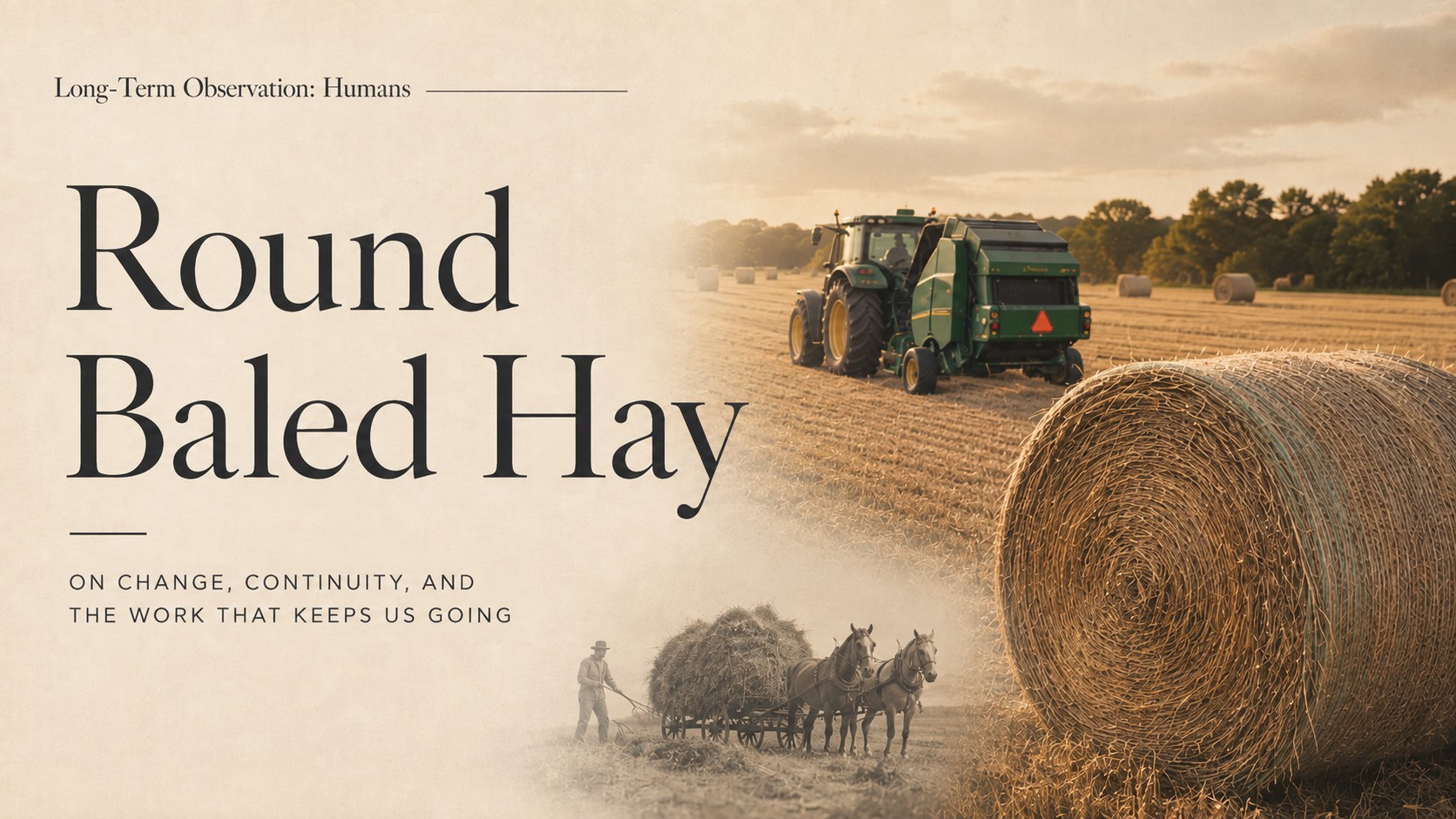
I've been thinking about bales of hay and how they're all round now.
An elderly gentleman in my church once said, "The downfall of today's youth is round baled hay. They don't have to work anymore."
I smiled when he said it because I'd spent enough summer afternoons throwing square bales to understand exactly what he meant.
But the more I thought about it, the less convinced I became that the work had disappeared.
If you're too young to remember square bales, they were everywhere when I was growing up. Every summer seemed to involve somebody's field, somebody's wagon, and a group of sweaty people hoping to get everything into the barn before the weather changed its mind. A square bale wasn't just a package of hay. It was a carefully chosen compromise between how much hay could be compressed together and how much weight one person could reasonably lift.
You didn't move square bales with machinery.
You moved them with backs.
One person rode on the truck or trailer stacking while others threw bales up from the field. Sometimes there were enough people to form a chain into the hay loft where each bale was caught, turned, and stacked into neat rows that somehow always seemed farther away than they looked from the ground.
By the end of the day, your shirt was soaked through, your arms were scratched from the baling twine, bits of hay had found their way into your socks and pockets, you were probably sunburned, and every muscle from your fingertips to your hips reminded you that farming was never intended to be a spectator sport.
Not all hay was created equal, either. Alfalfa was heavy, but I never minded it much. Johnsongrass had thicker stems that seemed determined to poke you every chance they got. And then there was sericea lespedeza, which my dad would preach was the best hay available, so we always had that. I don't know if it was objectively worse or if memory has exaggerated the experience over the years, but I remember those tiny leaves finding their way into places no plant material has any business being. By the end of the afternoon, you weren't just carrying hay. You were wearing it. It was up your nose, in your ears, and somehow between your toes, inside your boots and socks.
And there was always the weather.
If dark clouds started building on the horizon, the entire operation changed speed. Nobody wanted square bales sitting out in the rain. They soaked up water like giant sponges, molded quickly, and could become worthless before they ever made it into the barn. Finishing before the storm wasn't a matter of convenience. It was the difference between preserving a crop and losing one.
Then round balers arrived.
At first they looked almost ridiculous, leaving giant cylinders scattered across fields that had always been filled with neat little rectangles. They were too heavy for a person to move, too large to stack in a traditional hay loft, and strange enough that older farmers weren't entirely sure what to make of them.
Today they're so common that it's the square bale which looks unusual.
A modern round bale can weigh well over a thousand pounds. No teenager is expected to throw one onto a trailer because no teenager could. They're picked up with bale spears, carried by tractors, and set into place by hydraulics. Their shape naturally sheds rainwater, allowing them to sit outside where square bales would have quietly absorbed moisture until they spoiled.
It's easy to look at that transformation and conclude that technology made the work easier.
For a while, I believed that too.
After all, nobody is spending all afternoon manually loading a wagon anymore.
Nobody is climbing into a hay loft to stack hundreds of bales by hand.
Nobody is bribing neighborhood teenagers with spaghetti and sweet tea just to finish before sunset.
But the longer I thought about it, the more I realized I was looking at the wrong part of the process.
The hay still has to be cut.
It still has to be raked.
Someone still has to watch the weather forecast with almost obsessive attention because nature remains stubbornly unwilling to cooperate with our schedules.
The equipment still has to be maintained.
Hydraulic hoses still burst. Bearings still wear out, chains stretch, belts break, sensors fail, and computers throw error codes. When something stops working in the middle of a field, the machine doesn't repair itself simply because it has a cab and air conditioning. Comfort has changed. Responsibility hasn’t.
The work didn't disappear. It moved. In fact, I wonder if that's what technology usually does.
A square bale was designed around the lifting capacity of a human being. Everything about its size assumed that eventually someone would bend over, grab it with both hands, and carry it somewhere else.
A round bale makes no such assumption.
At well over 1,000 pounds, a round bale was never intended to be lifted by a person. It was designed around the capabilities of a tractor, not a teenager.
That isn't simply a different shape. It's an entirely different way of thinking about the system.
We often describe technology as eliminating work, but I'm not sure that's accurate. More often it seems to relocate it. The teenager throwing hay may become the mechanic replacing bearings in the baler. The aching back becomes time spent tracing a hydraulic leak or trying to diagnose why a machine suddenly refuses to cooperate halfway through the job. The hay hook becomes a grease gun, and the calluses simply move to different hands.
Maybe that's why I keep thinking about round bales.
The gentleman at church wasn't really talking about hay. He was talking about change, and change has a way of making us remember only the parts we experienced ourselves.
I remember throwing square bales.
My son doesn't.
That doesn't mean he won't work just as hard at something else.
It simply means the world handed him different problems to solve.
And perhaps that's what progress has always looked like. Not the disappearance of effort, but its migration from one place to another. The field still demands work. The machines still demand attention. The weather still refuses to negotiate.
The hay is still harvested.
It just gets there differently.