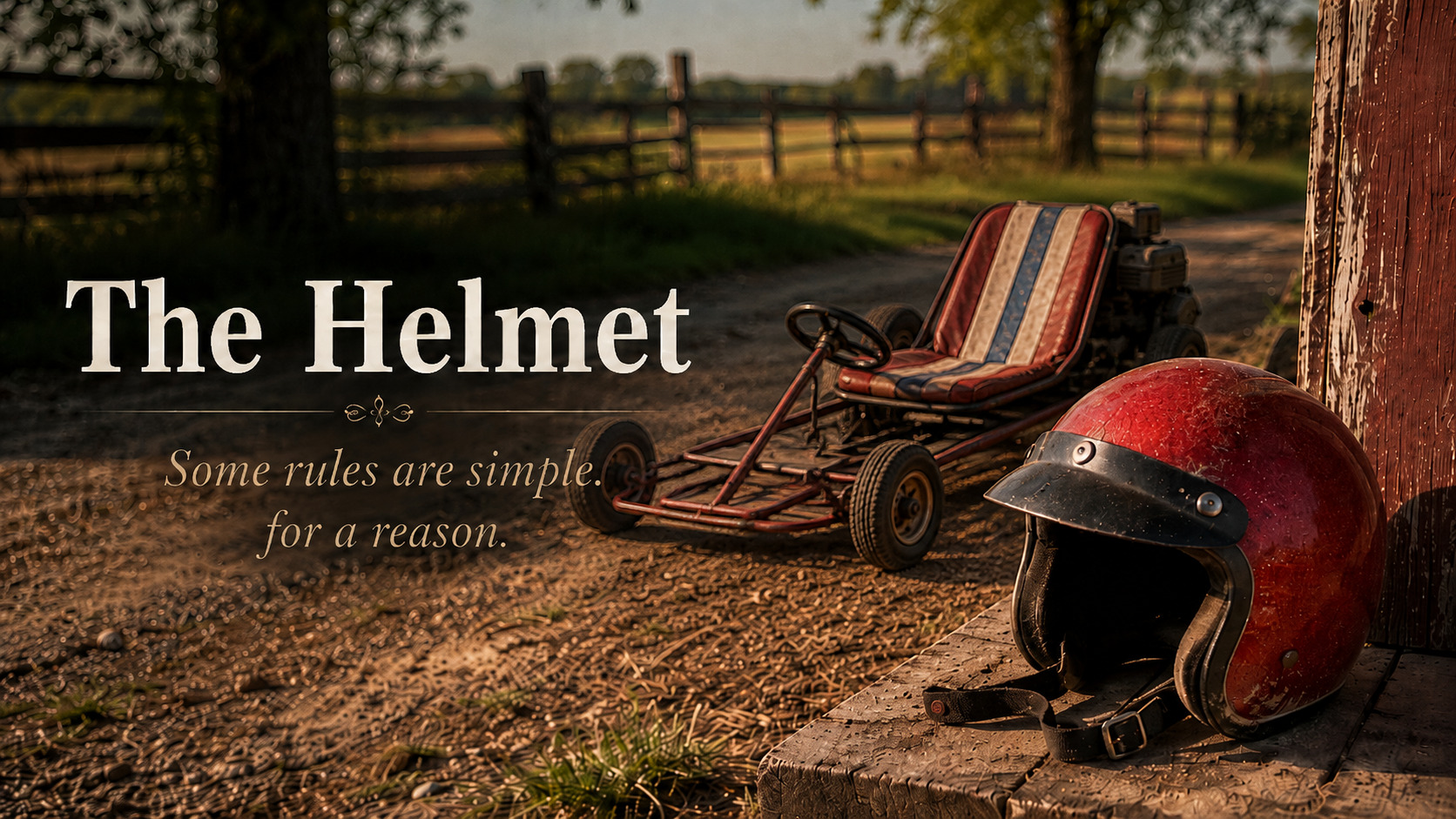
There were several go-carts in the neighborhood when we were kids, and we rode together whenever we could, but mostly I remember ours. It was red, with a single seat and a red, white, and blue pad that slipped over the seat frame. It had a five-horsepower engine, a centrifugal clutch, and positive traction. It sat low to the ground and was almost as fast as a Formula 1 race car.
At least that is how I remember it.
I also remember the donuts, the broken fence post, the scratched helmet, and one particular day pulling a sled in the snow. We probably put a hundred thousand miles on that little go-cart, though most of those miles happened in the backyard, through the pasture, and around the same familiar loops we rode over and over again. Childhood mileage is measured differently. A yard can become a racetrack. A pasture path can become a highway. A lap around the house can count as an expedition if the engine is loud enough.
That go-cart worked hard.
By the time it died, every part of it had been patched, repaired, adjusted, tightened, welded, bent back, or otherwise convinced to keep going. The tires were slick as glass again, because new tread apparently didn’t stay new for long when children discovered the joy of spinning in circles. The bearings had given up the ghost well before the whole machine finally quit. I am not sure it ever rode smoothly, but smoothness wasn’t the point.
Speed was the point.
Freedom was the point.
Noise was definitely part of the point.
I don’t really remember the day it died. That seems strange, considering how much I remember about riding it. I remember the paths. I remember the turns. I remember the feeling of sliding just a little too far and wondering if I was still in control. I remember the sound of the engine and the way the frame rattled beneath me. I remember grass, dirt, dust, and the particular confidence that comes from being a kid on a machine that feels much faster than it probably is.
But I don’t remember the final ride.
As far as I can remember, the go-cart was just there one day and dead the next. One day it was part of our lives. Then it wasn’t. It didn’t leave behind a dramatic final lap, at least not one I can recall. It just stopped being something we rode and started being something that used to run.
I sometimes wonder if its death came at the hands of Mom or Dad.
That may not be fair, but the evidence is suspicious. Unlike nearly everything else on the farm, repairing the go-cart was never really discussed. Things broke all the time, and usually someone talked about fixing them. Equipment could sit for months waiting on parts, time, money, motivation, or all four, but it remained repairable in theory. The go-cart didn’t seem to get that privilege.
It was dead one day and gone a few days later.
We still had the little dirt bike, which was arguably much more dangerous. A dirt bike will throw you farther, faster, and with more confidence than a go-cart ever could. But the dirt bike stayed. The go-cart disappeared. I don’t know when it left, where it went, or who made the decision. It was just gone, the way some childhood things disappear when the adults quietly decide the season for them is over.
Looking back, I cannot believe my parents gave us that go-cart in the first place.
Even more than that, I cannot believe they let us ride it unsupervised. We were children, in charge of a gasoline engine, a frame, four tires, and whatever judgment we had managed to develop by that point, which wasn’t much. We rode through the yard, around trees, across rough ground, along fence lines, and through places no responsible safety committee would have approved.
But there was one rule.
You had to wear the helmet.
That wasn’t a suggestion. That wasn’t a best practice. That wasn’t one of those rules adults say while knowing nobody will actually enforce it. On our go-cart, you wore the helmet. Somehow, Mom and Dad drove into our heads that if we rode without it, we would die. Not get hurt. Not maybe have an accident. Die.
That may sound dramatic, but it worked.
This was before helmets became a normal part of childhood. Now kids wear helmets to do almost anything outside. Bikes, scooters, skateboards, rollerblades, small electric things with wheels — somewhere along the way, helmets became part of the uniform. A kid headed outside today may look like he is preparing for reentry from space.
But we didn’t grow up wearing helmets for everything.
We rode bicycles without them. We ran, climbed, jumped, wrecked, fell, slid, and bounced off the ground without much protective equipment at all. The helmet didn’t become part of our lives until the go-cart came along.
It came with exactly one helmet.
It was red and sparkly, with a black sun visor and an open face. It looked official in a way nothing else about the go-cart really did. The go-cart may have been patched, repaired, rattling, and questionable later, but it didn’t start out that way. It started life at our house brand new, and so did the helmet.
That matters, because I remember how perfect that helmet looked when we first got it. The red sparkles were clean and bright. The black visor was smooth. The open face made it feel official without making it feel too serious. It wasn’t something we wore for bicycles or running around the yard. It belonged to the go-cart. It came with the go-cart. It made the whole operation feel faster, more dangerous, and somehow more approved.
And we didn’t just set it on our heads.
We wore it correctly. We pulled the strap under our chins and tightened it. We made sure it stayed where it belonged. We wore it like our lives depended on it, because apparently they did.
Nobody questioned it. Nobody negotiated. Nobody tried to argue that they were only going slow or only making one lap. No one else in the neighborhood seemed to have to wear a helmet on their go-cart, but anyone who rode ours wore the helmet. Friends, neighbors, cousins, whoever. If you got on our go-cart, the helmet went on your head.
And nobody complained.
That may be the most amazing part. Kids will complain about almost anything if they think there is room to complain. But somehow, with that helmet, there was no room. Mom had a way of making you do something because you wanted to, not only because you had to. I wish I had that ability now. I am not sure how she did it. Maybe she made the rule sound like common sense before we were old enough to question common sense. Maybe she made the consequence so clear that the decision felt like ours.
Whatever she did, it worked.
The helmet didn’t stay perfect long.
Over time, it collected scratches, scrapes, scuffs, and marks from all the things we survived. At the time, I probably saw those marks as normal wear. Looking back, they look more like evidence. Every scratch was a story we didn’t have to tell from a hospital bed. Every scrape meant something had gone wrong just enough for the helmet to do its job.
Thinking back about all the scratches and scrapes on that old helmet, it is a wonder we didn’t die.
Or maybe it isn’t.
Maybe that was the whole point of the helmet.
It was passed from rider to rider like a sacred object, or at least like the one item standing between us and immediate death. It wasn’t cool in the way helmets are cool now. It wasn’t decorated to match a bicycle or bought as part of some outdoor safety campaign. It was red, sparkly, open-faced, scratched up, and mandatory.
It was part of the go-cart.
Engine, tires, seat, steering wheel, helmet. All of it belonged together.
Except for one day.
The snow day.
Where we lived, there were no hills and usually no snow. At least not enough snow to speak of. North Alabama doesn’t organize itself around sledding. If you have a sled, most years it is more of a theoretical possession than an actual winter tool. It sits somewhere waiting for weather that may or may not arrive before the children who own it are too old to care.
But one year, sometime in the early eighties, we got five or six inches of snow.
That may not sound like much to people who live where snow is a regular part of winter, but in North Alabama, five or six inches was an event. It changed everything. The yard disappeared. The roads became questionable. The familiar world was covered in something rare enough that every child understood the day had to be used properly.
We had snow.
We had a sled.
We had no hills.
That was a problem.
At some point, someone had the bright idea to tie the sled to the go-cart and drag it around the front yard at breakneck speeds. I don’t know who thought of it, and I am not sure anyone would confess now if they did. But I will say this: as childhood engineering solutions go, it was brilliant. The lack of hills was solved by horsepower.
A five-horsepower go-cart may not sound impressive until it is pulling a sled full of screaming children across a snowy front yard.
It was one of the most fun days I can remember.
Everyone in the neighborhood took turns patiently. That is another thing I remember, because it seems unlikely and yet I believe it happened. We created a system. Everyone got three laps around the yard, and then it was someone else’s turn. Three laps on the sled. Three laps driving the go-cart. Or maybe the driving arrangement changed depending on who was trusted, who was oldest, or who could be convinced to give up the seat. However we managed it, we had a rule, and we followed it to the letter.
Children can create order when the reward is worth it.
We must have looked ridiculous. A go-cart dragging a sled across a North Alabama yard while kids waited in line for their turn like we were operating a winter amusement park. Snow flying. Engine running. Sled sliding. Children laughing. No hill required.
Then Mom stepped out the front door.
She yelled at us to stop.
The go-cart shut off immediately.
You could hear a pin drop, and snow makes that silence even worse. Snow muffles sound anyway, but fear can do its part too. For a few seconds, the whole yard went still. Every child there knew we were dead. We had tied a sled to a go-cart. We had created a high-speed snow machine out of farm-kid logic and neighborhood enthusiasm. We had clearly gone too far.
I don’t know what everyone else thought in that moment, but I was confident the fun was over.
Possibly our lives too.
Mom pointed toward us and said, “Put the helmet on the kid on the sled!”
Then she went back inside.
We stood there for a while trying to decide if she was serious.
Because this created a problem. You couldn’t ride the go-cart without the helmet. That was the law. That had always been the law. The helmet belonged on the driver. Every rule, warning, and parental commandment we had ever received confirmed this. But now Mom had issued new guidance from the front door, and apparently the child being dragged behind the go-cart at unreasonable speed was the one in greater need of head protection.
Looking back, she was probably right.
At the time, it felt like the world had shifted.
I don’t know how long we stood there. It may have been thirty seconds. It felt like five minutes. We had to process the fact that we weren’t in trouble, at least not in the way we expected. We had to absorb the fact that the sledding operation hadn’t been shut down. It had merely been brought into compliance.
So we put the helmet on the kid on the sled.
And we kept going.
Looking back, I am surprised none of us died that day. Either from being slung off the sled and rolling across the frozen front yard, or from Mom’s hand if we had failed to follow her helmet rule. But somehow we survived. We survived the snow, the sled, the go-cart, the turns, the speed, the questionable rope arrangement, and the uneven decision-making of children given access to machinery.
That may be the most amazing thing about childhood.
So much of it looks dangerous in hindsight because it was. Not always in an irresponsible way, but in the way childhood used to include more room for trial, error, bruises, luck, and the occasional adult yelling from the door. We weren’t neglected. We were loved. We were protected. But protection didn’t always mean removing every hazard. Sometimes it meant installing one hard rule and letting us discover the edges of the rest.
Wear the helmet.
That was the rule.
The go-cart could spin donuts. It could jump bumps it was never designed to jump. It could slide through grass, throw dust, break fence posts, and tow a sled through snow. It could run until the tires were slick and the bearings were tired. It could be patched and repaired and patched again. It could carry us through more childhood than any machine that small should have been able to carry.
But you wore the helmet.
Eventually, the go-cart disappeared, and I don’t remember saying goodbye to it. That may be the way it is with the things children love hardest. We don’t always notice the final day because we don’t know it is final. One afternoon is just one more afternoon until, later, we realize there were no more after it.
The go-cart was there.
Then it was dead.
Then it was gone.
But I remember it.
I remember the red frame and the red, white, and blue seat pad. I remember the low stance and the engine that felt far more powerful than five horsepower had any right to feel. I remember the slick tires, the rattles, the repairs, the dust, the donuts, and the scratched helmet. I remember believing we were moving impossibly fast through a world that was still small enough to fit inside a backyard and a pasture.
And I remember that snow day.
No hills. Rare snow. A sled. A go-cart. A yard full of neighborhood kids. A rule followed carefully until Mom clarified the rule none of us knew we needed.
Put the helmet on the kid on the sled.
That may have been Mom’s gift: not just making us obey, but making safety seem like part of the adventure instead of the end of it.
I still don’t know how she did that.
I wish I did.