Right before I turned sixteen, Dad and I found a Camaro that we were going to buy for my first car. It was black with chrome wheels and white letter tires, and to my almost-sixteen-year-old eyes, it was the most awesome car I had ever seen. I could already picture myself driving it. I don’t remember every detail about the car, but I remember the feeling. That car looked like freedom, noise, speed, and every reason a sixteen-year-old boy wants to be seen.
I couldn’t wait to turn sixteen.
I had already been driving off and on for at least a year, and I had been legally riding a motorcycle since I was fourteen. But sixteen was different. Sixteen meant I could finally drive legally. Not just around the farm. Not just here and there. I could drive cars, trucks, anything. At sixteen, the whole world seemed like it was about to open up through a driver’s side door.
Then my birthday came, and my plans got changed for me.
After school that day, I went out to Paw-William’s house to help feed the cows. At some point, he asked if it was my birthday. I proudly told him it was, because being sixteen felt important. It was one of those ages that seemed to come with a line drawn through life: before sixteen and after sixteen.
He listened, then pointed out into the pasture.
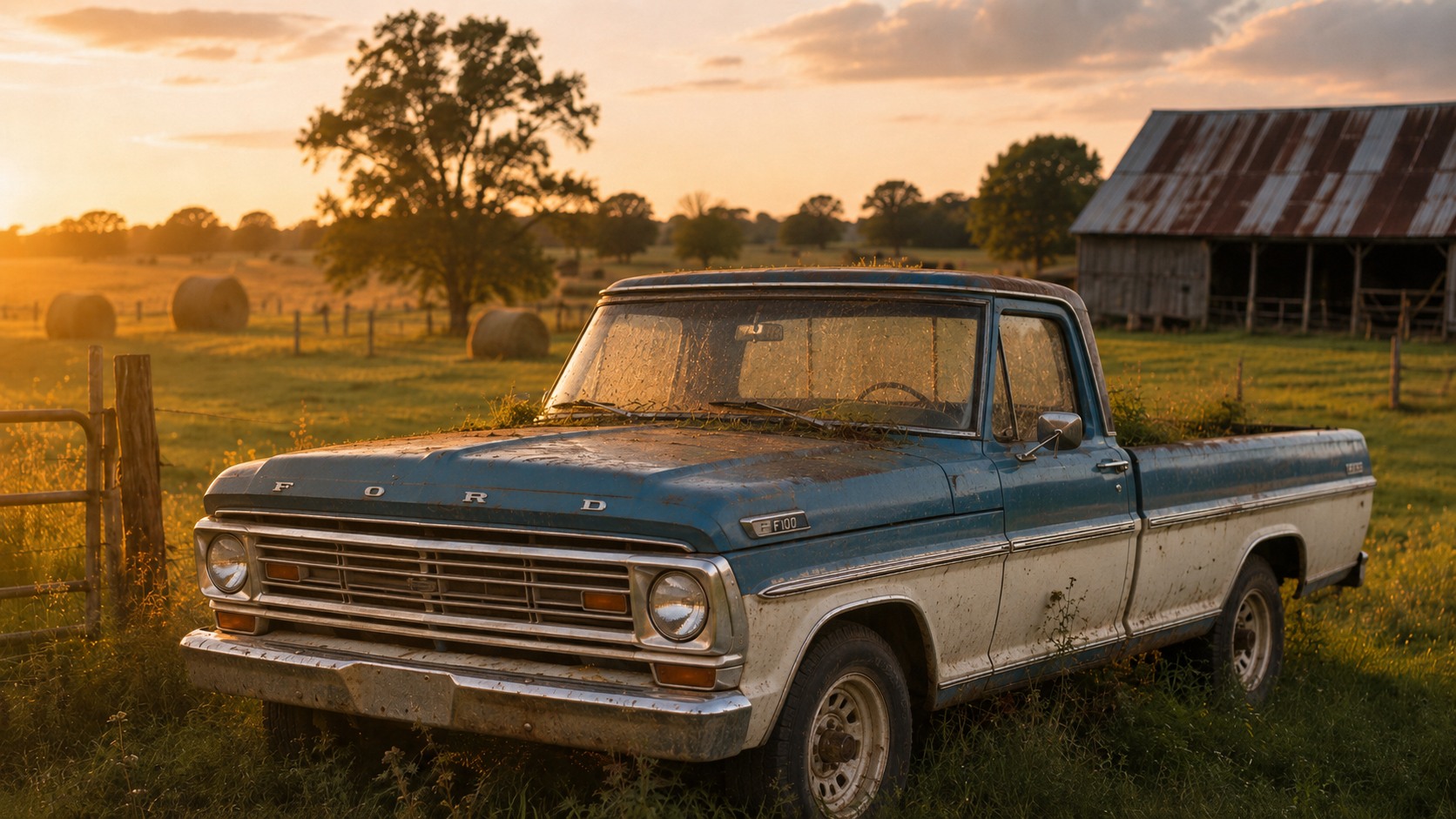
There sat an old blue and white Ford truck.
It had been sitting there as long as I could remember. In fact, it had been sitting there so long that I had stopped noticing it. That happens with old farm things. A piece of equipment, an old truck, a stack of lumber, a gate leaning against a tree — after a while, it stops being an object and becomes part of the scenery. You don’t look at it because your brain has already decided it isn’t going anywhere.
Paw-William pointed at that old truck and said, “Why don’t you take that old truck and drive it?”
I was floored.
There was no way I was giving up a black Camaro with chrome wheels and white letter tires for a raggedy old farm truck that was literally four years older than I was. No way. That truck wasn’t a first vehicle. It was a punishment with a steering wheel. It had grass growing on the roof and in what was left of the bed. It looked like something you would drag out of a pasture to make room for something better.
I tried to be polite.
I told him it was okay, that Dad and I already had something picked out. I thought that would settle it. I thought I had explained the situation clearly. There was a Camaro in the world, and I was on my way to it.
Then Paw-William floored me again.
He said, “Nope, I talked to your dad, and he’s coming out here this afternoon to help you get it.”
No way.
This wasn’t how sixteen was supposed to start. Sixteen was supposed to begin with the promise of a Camaro, not with a pasture truck being returned to society against my will. I remember feeling trapped by other people’s decisions, which may be the most sixteen-year-old feeling there is.
When Dad showed up, I still had hope.
I thought maybe he was just humoring Paw-William. Maybe he would say we appreciated the offer, but we weren’t actually going to take that old truck. Maybe he would look at it and realize no reasonable person would expect a teenage boy to drive it, especially not when a Camaro was already within reach.
I was wrong.
Very wrong.
Dad did say we would only take it if it ran, which gave me a little hope. That truck had been sitting in the pasture for years. Grass was growing on it. Time had clearly been chewing on it. There was no way it was going to start. I could almost see the Camaro coming back into view.
Then we put a new battery in it, added five gallons of fresh gas, and that old truck started right up.
It ran like a top.
Holy cow.
That was a bad day to be a sixteen-year-old boy.
We took that old piece of crap home. I don’t know what else to call it at that stage, because that is exactly how I saw it. We took the sideboards off and washed it about five times to get all the grass, dirt, and pasture funk off of it. Washing it helped, but it also took off a good bit of what was left of the paint, so in some ways it looked even worse before it looked better.
Eventually, we put new tires on it. It got a new seat cover. It got a new paint job. Slowly, reluctantly, painfully, it began to look less like a forgotten farm truck and more like something a person might actually drive on purpose.
It wasn’t a Camaro.
But apparently, it was my truck.
That took some adjusting.
A Camaro would have announced something. That old Ford truck mostly explained something. It explained that I lived around farms, tires, hay, boats, work, family, and things that needed to be hauled. It explained that even at sixteen, my life wasn’t going to be arranged entirely around what looked cool in a parking lot.
At first, I resented that.
Then, little by little, I started to understand the truck.
It could pull the boat. A Camaro wouldn’t have done that, at least not in any way that made sense. The truck could haul hay, which meant it could help us make money over the summers. It could haul tires for the tire store. It could carry tools, feed, junk, equipment, and whatever else needed to move from one place to another. It could haul friends around the square on Friday nights, which mattered more than I might have admitted at the time.
A Camaro could have carried me.
That old truck could carry a life.
That isn’t something I understood on my sixteenth birthday. On that day, all I saw was what I was losing. I saw the chrome wheels and white letter tires disappearing. I saw myself driving something old, square, practical, and embarrassing. I saw freedom being replaced with responsibility before I had even backed out of the driveway.
But over time, the truck became mine in ways the Camaro might not have.
It wasn’t sleek. It wasn’t fast. It wasn’t the car I wanted people to notice for the reasons a teenage boy wants to be noticed. But it was useful, and useful has a way of earning affection. Every load of hay, every trip to the tire store, every errand, every Friday night lap around the square added something to it. The truck began as Paw-William’s old pasture truck, then became the thing Dad and I dragged back into service, and finally became my truck.
And even then, it didn’t stay only mine.
That old truck stayed in the family for about fifteen years. My brothers both drove it. Dad drove it for a while. Eventually, after another truck of mine broke down, it came back to me again. By then, it had become less like a vehicle someone owned and more like a tool the family kept passing to whoever needed it next.
That seems right for that truck.
A Camaro wouldn’t have done that. A Camaro would have belonged to one person, maybe two if somebody was feeling generous with the keys. But that old Ford was different. It could be cleaned up, passed around, borrowed, used, returned, neglected, fixed, and brought back into service when life needed a truck again.
It had already done that once when we pulled it out of Paw-William’s pasture.
I suppose it just kept doing it.
That is a different kind of cool.
Maybe not the kind I wanted at sixteen, but the kind I understand better now.
I still think about that Camaro sometimes. I wonder how it would have felt to drive it, which is funny because I don’t think I have ever actually driven a Camaro in my life. I have looked at similar Camaros over the years, and I have thought, more than once, that maybe I should own one at least one time just to make peace with the one that got away. But I have never even test driven one, new or old.
That probably says something.
Maybe that is why the Camaro still has such a clean shine in my memory. I never had to live with it. I never had to insure it, repair it, wash it, get in and out of it, or discover whether it was as good as I imagined. The truck had to prove itself in the real world. The Camaro got to remain an imagined life I never even test drove.
The funny thing is, that Camaro would be an old Camaro now. Back then, it was just the car I wanted. Time has a way of turning even our almost-dreams into classics.
There were always reasons I never bought one. Money. Timing. Priorities. Practicality. Space. Other vehicles. Other responsibilities. Life kept offering reasons not to buy the Camaro, and I kept accepting them.
Now I am fifty-five, and getting in and out of a Camaro no longer sounds like the kind of dream I need to chase very hard. At some point, a person has to admit that some dreams age differently than others. The sixteen-year-old version of me wanted to slide behind the wheel of that black Camaro and be seen. The fifty-five-year-old version of me thinks about knee room, door height, insurance, and whether I would make a noise getting out of it in a parking lot.
Time is rude that way.
Still, I don’t think the Camaro dream was foolish. It was exactly the kind of dream a sixteen-year-old boy should have. There is nothing wrong with wanting something fast, shiny, loud, and impractical when you are standing at the edge of driving age and imagining the world opening up.
But Paw-William gave me a truck.
At the time, that felt like the opposite of a gift.
Looking back, I am not so sure.
He gave me something that ran when it had no business running. He gave me something that needed cleaning, fixing, and making mine. He gave me something useful before I was old enough to understand how much usefulness matters. He gave me a vehicle that could fit the life I actually had, not just the life I imagined having when I looked at a black Camaro with chrome wheels and white letter tires.
I don’t know whether he saw all that.
Maybe he just had an old truck in the pasture and a grandson turning sixteen. Maybe he knew Dad would rather see me in something practical. Maybe he thought he was helping. Maybe he thought no good truck should sit unused when there was someone old enough to drive it.
Whatever the reason, the truck changed my plans.
And eventually, I changed my mind.
That is hard to admit, because the sixteen-year-old version of me would still be mad about it. He would still say the Camaro was cooler. He would still argue that birthdays shouldn’t include unwanted farm trucks. He would still point out, correctly, that grass growing on the roof isn’t a selling point.
He wouldn’t be wrong.
But he wouldn’t be entirely right either.
Sometimes the thing we want and the thing that fits us aren’t the same thing. Sometimes the gift doesn’t feel like a gift until years later, after it has hauled hay, pulled boats, carried friends, made money, gone to someone else, come back when needed, and become part of the stories we still tell.
The old truck is sitting in a scrap yard now, close enough to the road that I can still see it occasionally when I pass by. It isn’t in the pasture anymore. It isn’t in our driveway. It isn’t hauling hay, tires, boats, tools, brothers, friends, or anybody around the square on a Friday night. It is just sitting there among other things that once had engines, owners, purposes, and stories.
Every now and then, I catch sight of it.
And I wonder.
I wonder if a new battery and five gallons of fresh gas would still be enough. I wonder if that old truck has one more start left in it. Maybe that is foolish. Maybe time has done what time does, and no amount of gas or hope would bring it back now.
But part of me remembers a pasture, a birthday, a truck that had no business running, and an engine that started right up like it had only been waiting for someone to ask.
I never got that Camaro.
I got an old blue and white Ford truck instead.
And somehow, after all these years, that is the one I keep looking for.