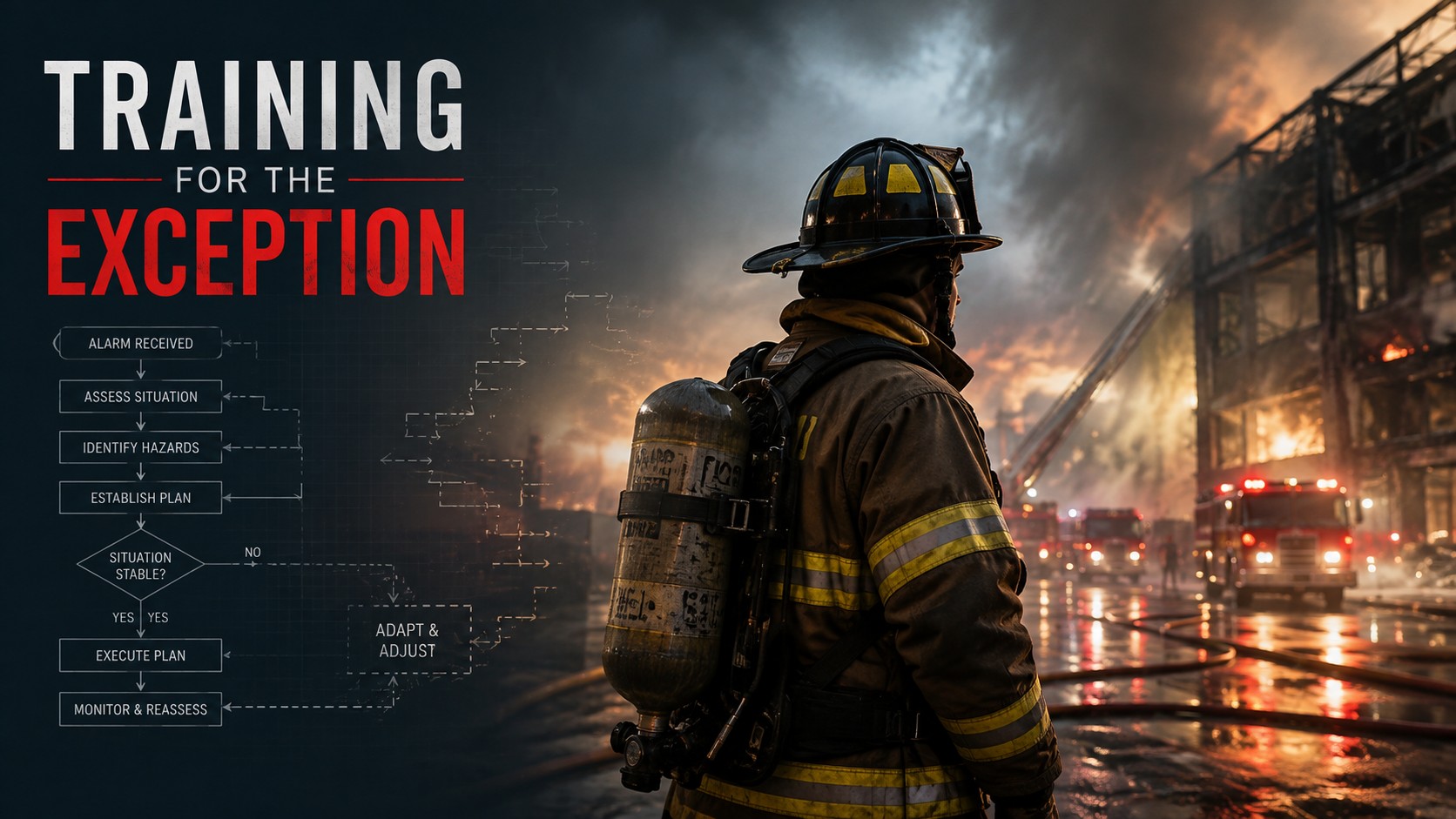
Our fire department has a simple motto:
“When things go wrong, we go to work.”
It is a good description of emergency services in general. We know before the call ever comes in that no two incidents will be exactly the same. The information we receive is usually incomplete, and conditions can change before we arrive. Equipment fails. Access may be blocked. The first plan may not work.
So we train for it.
That does not mean we ignore procedures. Quite the opposite. Emergency services depend on procedures, standard tactics, checklists, command structures, and repetition. But we also understand that a procedure is only useful as long as the situation still fits the assumptions behind it. We learn the standard way first, then we learn enough about it to recognize when the situation is no longer standard.
That leads to what I think are three different levels of competence.
Level 1: Know the Procedure
The first level is straightforward: learn the process. When this happens, do that. If this condition exists, take this action. Complete these steps in this order.
But learning the procedure is not the same as knowing it. To really know a procedure, you have to practice the right procedure until you do not do it wrong. The correct sequence needs to become familiar enough that you are not stopping to remember what comes next or falling back on a shortcut simply because it is easier.
That repetition matters. In emergency services, we practice basic skills over and over for a reason. When conditions become complicated, the fundamentals should not be the part consuming your attention. You need enough familiarity with the standard procedure that you can recognize when the situation in front of you is no longer standard.
The same principle applies in other work. People need to know the approved process, the required sequence, the safety controls, and the boundaries of their authority. A person who does not truly know the procedure is not prepared to deviate from it intelligently. Deviating because you do not know the right way is a mistake. Recognizing that the right way does not fit the current conditions is something very different.
That is where the second level begins.
Level 2: Understand the Procedure
There is an important difference between knowing what to do and understanding why you are doing it. Why does this approval exist? Why is this step performed before the next one? What risk is this control intended to prevent? What is the actual objective of the process?
Once someone understands those things, the procedure stops being a list of instructions and starts becoming a model of how the work is supposed to function. That matters because eventually something will not fit the model.
A system will be unavailable. Information will be missing. Two requirements will conflict. A customer will present a situation no one included in the training example. Equipment will behave differently than expected. The person in front of you will not fit neatly into the flowchart.
If all someone has learned is the sequence, that may be where their competence ends. If they understand the reason behind the sequence, they have something more useful to work with. They can begin to distinguish between what is essential to the process and what is simply the normal way of accomplishing it.
That understanding is what makes the third level possible.
Level 3: Function Beyond the Procedure
This is the level that is much harder to teach: what do you do when the procedure runs out?
Emergency services deal with this constantly. We do not attempt to write a procedure for every possible incident because that would be impossible, and we cannot play an endless game of “what if.” What if access is blocked? What if the hydrant does not work? What if the victim is somewhere unexpected? What if the building layout is different? What if several problems happen at once?
There is no end to that list.
Training can expose responders to different situations, but the goal is not to teach every possible exception. The goal is to make sure they know the procedure, understand why it exists, and have enough command of the fundamentals to apply them when reality presents something they have never seen before.
Once the script runs out, one of three things usually happens.
The first possibility is that the person stops because they genuinely do not know what to do next. That can be the correct response. Recognizing the limits of your knowledge and stopping, asking for help, or escalating the decision is far better than pretending to know something you do not.
The second possibility is that the person guesses. They know they do not know how to handle the situation, but they make a choice anyway without enough understanding to support it. They are no longer following a procedure, but they are not exercising informed judgment either. This is where problems are often created.
The third possibility is that the person intelligently negotiates the situation. They understand the objective, the risks, the boundaries, and the reasoning behind the procedure well enough to evaluate what still applies and what has changed. They may adapt the plan, request additional resources, stop part of the operation, or choose another reasonable path.
The first and third responses can both be signs of competence. The second usually is not.
Knowing when to stop is part of judgment. So is knowing when you have enough understanding to continue. Training for the exception is not about giving people confidence to improvise. It is about giving them enough knowledge to recognize the difference between a decision they are prepared to make and one they are not.
Once responders truly know the procedure and understand the reasoning behind it, they are ready to face an endless number of “what ifs.” Those situations do not have to be invented in the classroom. Reality will provide more than enough of them.
You Cannot Flowchart Everything
Organizations understandably like predictable processes. Flowcharts are easy to teach, repeatable, consistent, and relatively easy to audit. They provide a documented path that can later be reviewed: if this, then that. There is nothing inherently wrong with that.
The problem comes when we begin to believe the flowchart represents the entire job. More and more decisions in many professions are supported by protocols, decision trees, software prompts, standardized forms, and required sequences. Many of those tools exist for good reasons, but there is a difference between using a process to support professional judgment and using a process to replace it.
A flowchart can only contain situations someone anticipated when the flowchart was created. Reality is under no obligation to cooperate.
That is why the answer is not to keep adding branches forever. More procedures eventually create a larger flowchart, but they do not eliminate uncertainty. There will always be another combination of circumstances that no one thought to include.
Training cannot prepare people for every situation.
It can prepare people to face situations for which they were never specifically trained.
Have We Confused Compliance With Competence?
This may be where organizations create an unintended problem. It is relatively easy to determine whether someone followed a procedure, but it is much harder to determine whether someone actually understands the work. A training program can verify that an employee knows which button to push, which form to complete, or which step follows the previous one. That still does not tell us what will happen when none of the available choices quite fits the situation.
We may be producing people who are very good at navigating systems but less comfortable making decisions when the system cannot provide the answer. That raises a larger question: Have we become so focused on teaching people what to do that we have stopped teaching them how to decide?
The distinction matters because procedural compliance and competence are not the same thing. A person can follow a process perfectly and still have very little understanding of why it works. Another person can understand the process deeply enough to recognize when following it blindly would create a problem.
Competence includes knowing the procedure, understanding it, and recognizing the limits of both your authority and your knowledge.
Common Sense Is Not Enough
The answer is not simply to tell people to “use common sense.” Common sense is inconsistent, heavily dependent on experience, and often seems obvious only after something has already gone wrong. Good judgment needs something more substantial behind it.
It requires knowledge of the fundamentals, an understanding of the objective, and a clear sense of which boundaries are flexible and which are not. It also requires the ability to recognize risk and enough experience—or enough realistic training—to notice when something is no longer normal.
That is what makes the emergency-services model useful outside emergency services. We do not train people by simply telling them, “If something unexpected happens, figure it out.” We give them a foundation first. We teach the procedure until they know it, teach the reasoning until they understand it, and then expect them to use both when reality no longer matches the example.
The Third Level Is the Hardest to Measure
The first level is relatively easy to test: can the employee describe and perform the procedure correctly? The second level is harder: can the employee explain why the procedure exists, what it is intended to accomplish, and what risks it is designed to control?
The third level is harder still. Can the employee recognize that the procedure no longer fits the situation and make a reasonable decision about what should happen next?
Scenario-based training can help answer that question, but scenarios should be treated as samples, not as a catalog of future problems. The purpose is not to expose someone to every situation they may encounter. It is to see whether they can apply what they know when one or two important conditions change.
A useful training exercise may ask, “What would you do if...?” and then change part of the situation. It may present a problem with no perfect answer and ask the employee to explain the reasoning behind the decision. It may also reveal something equally important: whether the person recognizes that they have reached the limit of what they should decide on their own.
That is why stopping can be a successful outcome. If someone recognizes that the situation exceeds their knowledge, experience, or authority and asks for help, the training has not failed. The employee has demonstrated judgment.
What we should be trying to avoid is the person who reaches the end of the script, knows they do not know the answer, and guesses anyway.
When the Flowchart Ends
Most workplaces are not emergency services, and most employees should not spend their days expecting things to go wrong. But sooner or later, every organization encounters a situation the process did not anticipate. At that moment, the employee has reached the end of the flowchart.
When that happens, they can stop because they recognize that they do not know what to do next. They can guess because they know they do not have the answer but feel compelled to do something anyway. Or they can intelligently negotiate the situation using the knowledge, understanding, and judgment they have developed.
The first and third can work. The second usually does not.
If we have only trained people to know the procedure, we should not be surprised when they struggle after the procedure ends. If we have taught them why it exists and helped them develop the judgment to recognize what still applies when conditions change, we have developed something much more valuable than procedural compliance.
We have developed competence.
In emergency services, we know that moment is coming, so we train for it. When things go wrong, we go to work.
Maybe more organizations should train their people for what happens when the script runs out.