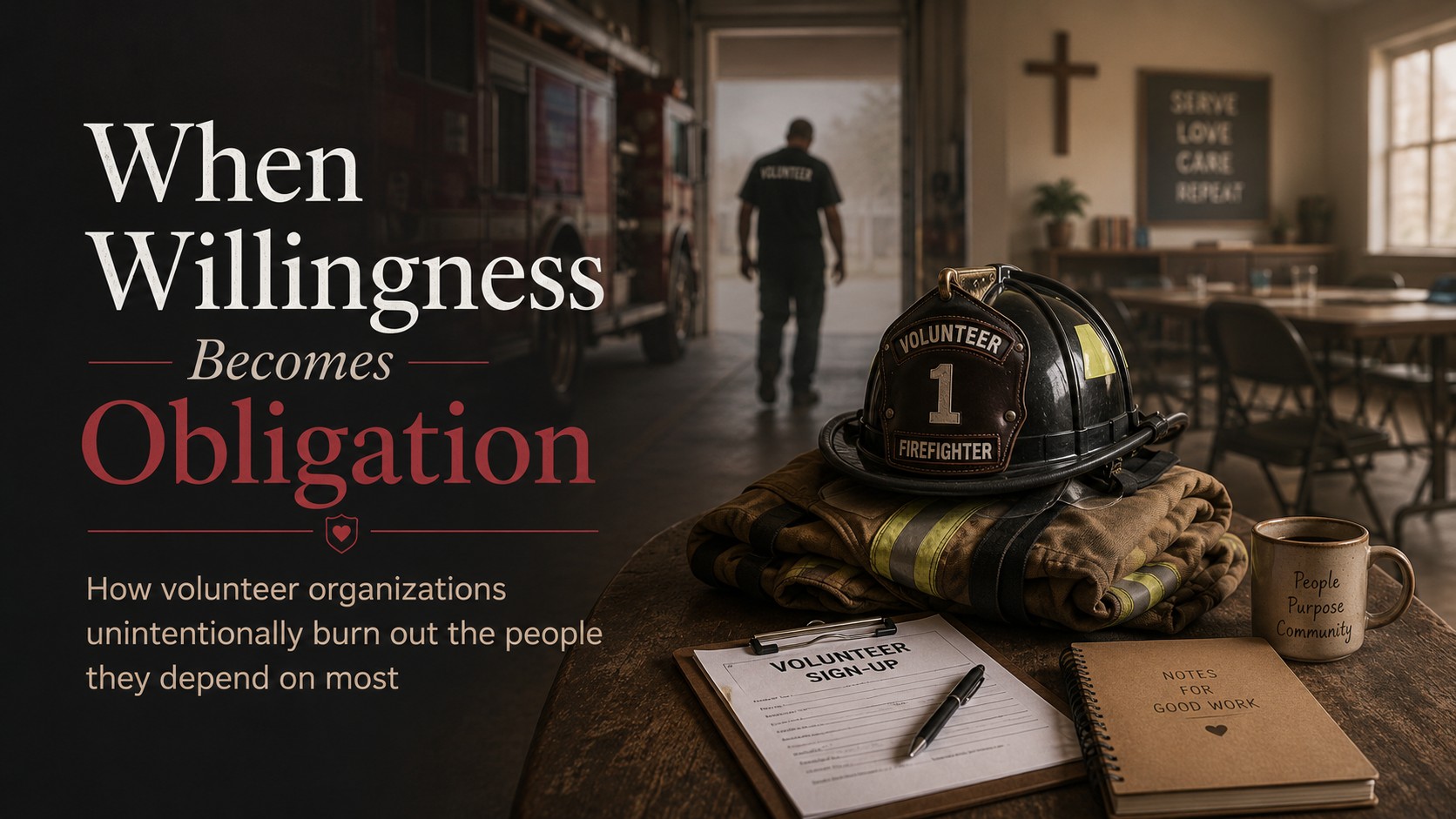
I’m a volunteer firefighter. I say this not asking for recognition, but to say that I’ve seen volunteer burnout firsthand and have experienced some of it myself. I’ve also volunteered at my church as a teacher, among other roles, and I saw the same pattern there.
Volunteer burnout is not something new, but it is something we need to recognize and address in our volunteer organizations. Unfortunately, volunteers are often few and far between, so the people who do step forward usually end up taking on much more than they originally intended.
The Reliable Volunteer Problem
It rarely happens all at once. Someone volunteers for one responsibility because they have the time, the ability, or simply the willingness to help. Then another need comes up. Since that person has already proven dependable, they are asked again. Before long, the person who volunteered to do one thing is doing four or five.
The problem is that organizations tend to lean hardest on the people who are most reliable. In the short term, that makes perfect sense. If something needs to be done, you naturally ask the person you know will do it. Over time, though, reliability can become a liability. The volunteer who always says yes becomes the first person everyone calls. Their willingness becomes expected, their extra effort becomes normal, and what began as service slowly starts to feel like responsibility.
We sometimes unintentionally reward good volunteers with more work. Someone does a good job, so we give them another responsibility. They handle that well, so we give them another. Eventually, the most dependable volunteer becomes the most overloaded volunteer.
Burnout Is Not Always About Time
I don’t think volunteer burnout is always about the number of hours involved. Sometimes it is about the loss of choice. There is a significant difference between saying, “I want to help with this,” and feeling, “If I don’t do this, nobody else will.” There is also a difference between being appreciated for helping and becoming responsible for something simply because you helped with it once before.
Volunteer organizations can unintentionally create this problem because there is rarely an abundance of people waiting to take on more work. When someone capable steps forward, the temptation is to keep handing that person responsibilities because the alternative may be that the work simply does not get done.
But if we continually solve volunteer shortages by increasing the workload of the volunteers we already have, eventually we may have even fewer volunteers.
People do not necessarily leave because they stopped caring about the mission. Sometimes they leave because caring about the mission became exhausting.
When Commitment Gets Misunderstood
A firefighter may still care deeply about serving the community but become tired of feeling expected at every event, training, fundraiser, workday, committee meeting, and administrative task. A church volunteer may still care deeply about the congregation but become exhausted after teaching a class, helping with events, serving on committees, filling in for absent volunteers, and continually being asked to take on “just one more thing.”
The mission did not become less important. The burden simply became too heavy.
This is where volunteer organizations have to be careful about how they define commitment. A person who cannot attend every event is not necessarily uncommitted. A person who says no to another responsibility is not necessarily unwilling to serve. A person who needs to step away for a while has not necessarily stopped caring.
Sometimes saying no is what allows someone to continue saying yes to the things that matter most.
Making Service Finite
My church eventually recognized some of this problem and instituted mandatory rest periods for certain volunteer positions. You could serve in a position for three consecutive years, and then you had to take a year off.
The idea made sense. It prevented the same people from simply remaining in the same roles indefinitely and gave volunteers permission to step away without feeling as though they were abandoning something.
Of course, that solution creates another challenge: someone else has to be willing to serve.
But there may be an advantage hidden inside that limitation. Asking someone to volunteer indefinitely can feel like a major commitment. Asking someone to serve for a defined period is different.
“There is no end date” is a much harder commitment than “Would you be willing to do this for a year?”
People may be more willing to volunteer when they know from the beginning what they are agreeing to. A defined term gives them an opportunity to help without wondering whether saying yes today means they will still be responsible for the same job five or ten years from now.
Term limits and rest periods will not work for every volunteer organization or every position, but the principle behind them is worth considering. Volunteer commitments should have boundaries.
Protecting the People Who Keep Showing Up
Leadership cannot wait for volunteers to announce that they are burned out. By the time someone finally says, “I can’t keep doing this,” they may already be halfway out the door.
We should be paying attention much earlier. Who is always being asked? Who has quietly accumulated responsibilities over the years? Who never seems to miss anything? Who is now doing work that used to be divided among several people? And when someone says no, do we allow no to be a complete answer, or do we immediately begin trying to convince them otherwise?
Maybe we should also ask another question: Are we making it easy enough for new people to say yes?
That may mean clearly defining the responsibility. It may mean dividing one large volunteer position into several smaller ones. It may mean establishing a beginning and an end instead of asking for an open-ended commitment. And it may mean accepting that occasionally something simply will not get done rather than continually asking the same dependable people to absorb more.
Volunteers are giving something that cannot simply be replenished with a paycheck. They are giving evenings, weekends, family time, energy, and attention, often after already working a full day somewhere else. That contribution deserves more than appreciation; it deserves stewardship.
If an organization depends on volunteers, then protecting those volunteers from unnecessary burnout should be part of protecting the organization itself.
The goal should not simply be to find people willing to serve today. It should be to create an environment where they are still willing to serve years from now.